AC-Coupled vs DC-Coupled Battery: Which Suits Your Solar?
Written and reviewed by Sepehr. See our editorial policy.
If you already have solar panels, an AC-coupled battery is the usual way to add storage without replacing your inverter, while a DC-coupled system is built around a hybrid inverter. The difference is where the battery connects. This guide explains how each works, what the efficiency numbers really say, and what the grid rules mean for a retrofit. For the wider picture, see our home battery installation guide.
How does AC-coupling work?
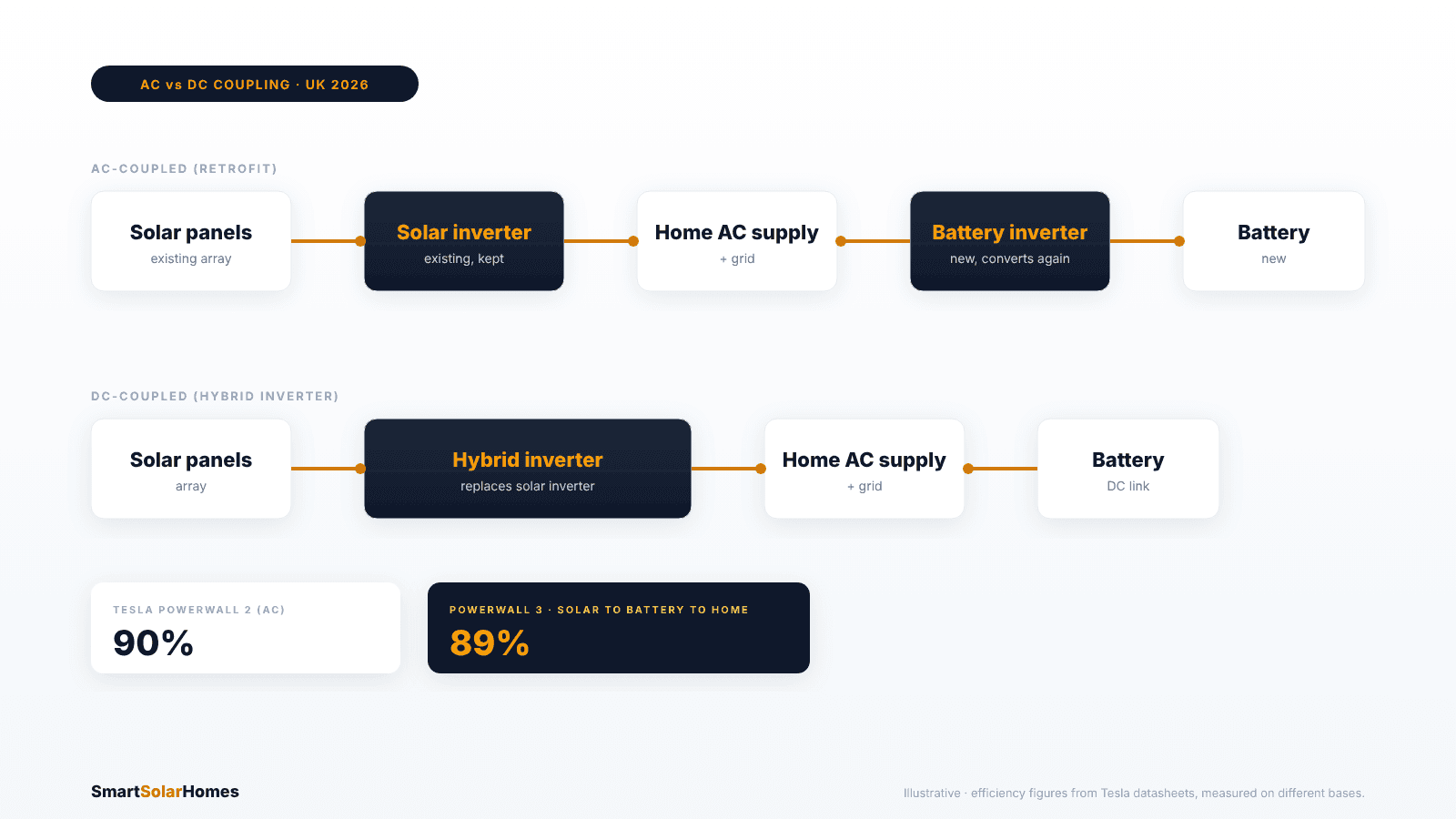
In an AC-coupled system the battery has its own inverter and connects to your home’s AC supply, alongside the existing solar inverter. Solar power is converted from DC to AC by the solar inverter first. To charge the battery it is converted back to DC, and converted to AC again on discharge. Tesla describes the Powerwall 2 AC in these terms, and its datasheet gives a round-trip efficiency of 90%, defined as “AC to battery to AC”, at beginning of life, 25°C and 3.3kW charge and discharge power (North American datasheet, 2023).
How does DC-coupling work?
In a DC-coupled system the panels and the battery share one hybrid inverter, so solar power can reach the battery without being converted to AC first. The usual consequence for a retrofit is that the existing solar inverter is replaced. Our hybrid inverter buyer’s guide covers what to look for.
Is DC-coupling really more efficient?
Fewer conversion steps does mean less loss in principle, but datasheet figures are hard to compare. Tesla’s UK Powerwall 3 datasheet lists a “Solar to Battery to Home/Grid Efficiency” of 89% for a typical use case where PV energy is stored and later released, and a separate “Solar to Home/Grid Efficiency” of 97.5%, tested using an EU weighted efficiency method. Those two numbers measure different things, and the 89% is not a like-for-like comparison with the Powerwall 2’s 90% AC-to-AC figure, which starts from the AC side and was tested at a different power level.
The practical lesson is to ask each manufacturer exactly what its efficiency figure covers (which conversions, what power, what temperature) before treating a few percentage points as a deciding factor. Installer blogs often put the gap at a few percent, but they are not independent evidence.
Which is better for adding a battery to existing solar?
- AC-coupled: keeps the existing solar inverter, adds a second inverter, and can be installed without touching the PV side. The MCS says that if you already have solar panels you can still add a battery, but you should check the battery is compatible with your existing or planned panels.
- DC-coupled: suits a new solar installation, or an old inverter you were going to replace anyway, because you buy one hybrid unit instead of two inverters.
If your inverter is young and working well, AC-coupling usually avoids paying for a replacement. If it is near the end of its life, a hybrid inverter may be the better use of the same money. See how long solar batteries last for the other half of that decision.
Do the grid rules change for a retrofit?
Yes, and this catches people out. The Welsh Government’s technical note on connecting on-site generation (first published 2 June 2026, updated 11 September 2026, written for the Welsh network operators) says battery storage capable of export is treated as generation, and that generation and storage capacity at the same connection point are considered cumulatively. Its thresholds are up to and including 3.68kW single phase (11.04kW three phase) for G98 connect and notify, and above that for G99, where you apply in advance. It also says network operators must authorise all installations of generating stations and battery storage systems, even where there is no intention to export.
The note does not spell out the route for adding a battery to an existing system, so ask your installer which route they are taking and check your own network operator’s guidance, since the note was written for Wales. For the notification process, see our G98 notification guide and DNO application guide. If you want to hold export down, our export limitation guide explains the option.
Will a battery affect Smart Export Guarantee payments?
Possibly. Ofgem’s SEG guidance for generators says that for PV up to 50kW, applicants are asked to show the installation and installer are suitably certified, which may be an MCS certificate or an equivalent scheme. It also says that where the export meter records electricity exported from a non-eligible source, such as a battery charged from something other than the SEG-eligible generation, a licensee is not obliged to make SEG payments for that export. It may pay for all of it, none of it, or require extra metering. If you plan to charge from the grid, ask your supplier how it treats that before you sign up. The guidance was published in December 2019, so confirm current supplier terms.
Which should you choose?
- Existing, working solar and you want storage: AC-coupled is usually the simpler route.
- New solar and battery together, or an inverter nearing replacement: look at a DC-coupled hybrid system.
- Either way: confirm the compatibility, grid route and SEG treatment in writing before committing.
Our Powerwall 2 vs Powerwall 3 comparison shows the two approaches side by side in one product family.
FAQs
Can I add a battery to my existing solar panels?
Is an AC-coupled battery less efficient than DC-coupled?
Do I need to tell my network operator about a battery?
Does adding a battery change which grid route applies?
Can I still get SEG payments with a battery?
Should I replace my inverter when adding a battery?
Sources — verified 22 November 2026
- Tesla, “Powerwall 3 Datasheet (UK, EN)” — energylibrary.tesla.com
- Tesla, “Powerwall 2 AC Datasheet” — digitalassets.tesla.com
- Welsh Government, “Connecting on-site generation to the grid: technical note” — gov.wales
- Ofgem, “Smart Export Guarantee: Guidance for generators” — www.ofgem.gov.uk
- MCS, “Battery storage” — mcscertified.com

About the author
Sepehr
Solar specialist & co-founder, Smart Solar Homes
Solar specialist and co-founder of Smart Solar Homes, which works with MCS-certified UK installer partners. I write all the guides and reviews here; the aim is straight-talking education the industry rarely provides.
Citing this page? Please use a dofollow link back to the original article — it helps us keep the data on this page accurate and up to date.
Browse Battery Storage on Smart Solar Homes


Want to compare these side by side? Use the compare tool →
Or browse all Battery Storage on Smart Solar Homes.
Related reading
More on battery storage from the editorial team.
Find installers near you
MCS-certified solar installers covering these areas.