Best EV Charging Tariff UK 2026: Compare Overnight Rates
Written and reviewed by Sepehr. See our editorial policy.
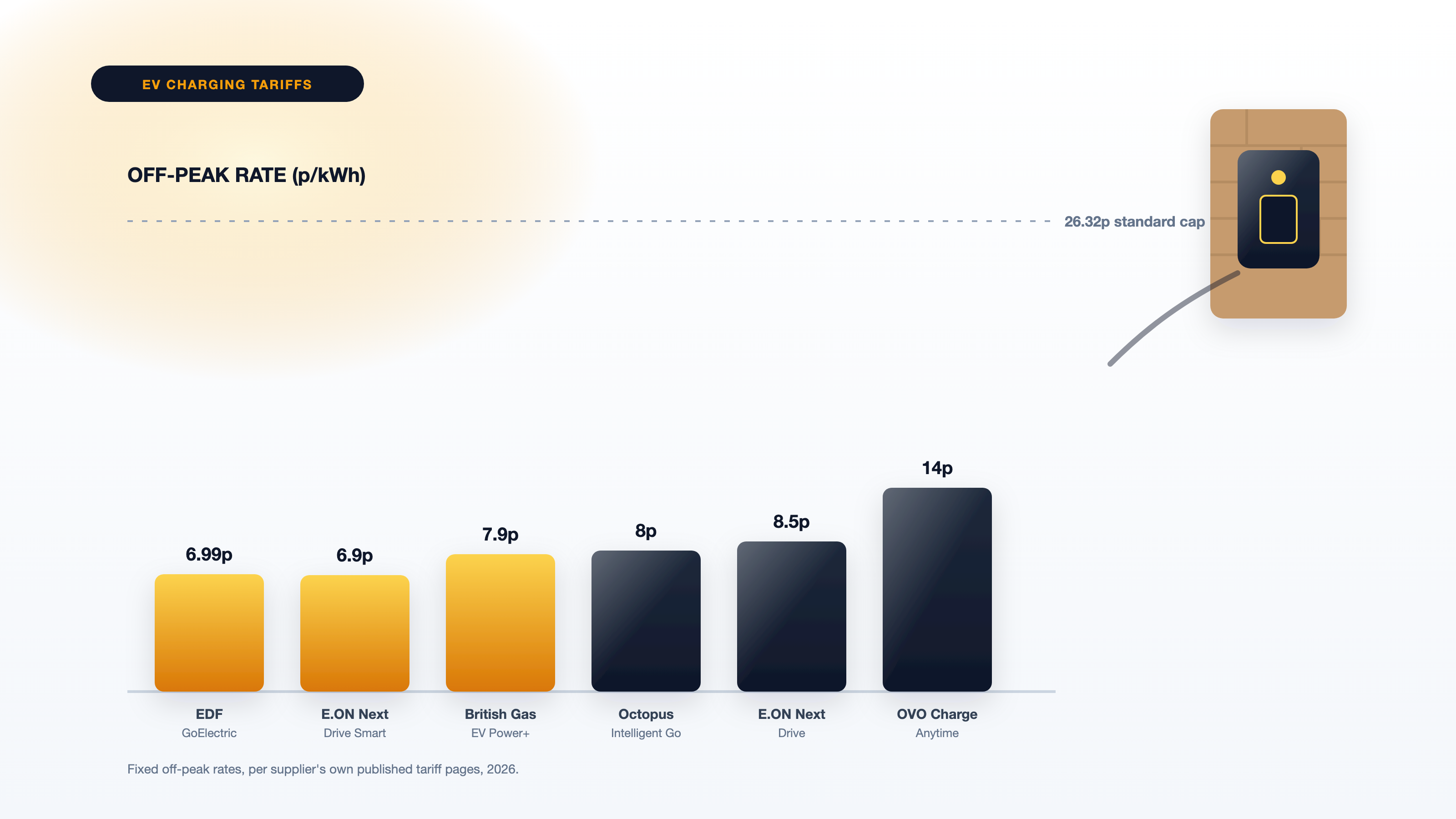
If you're charging an EV at home on a standard variable tariff, you're paying the same unit rate for every kilowatt-hour whether it's 3pm or 3am — around 26.32p/kWh under the October 2026 Ofgem price cap. Switch to a dedicated EV charging tariff and that overnight rate drops to somewhere between 6.9p and 9p/kWh, cutting a typical 8,000-mile-a-year charging bill by £300–£500 a year. The catch is that each supplier's tariff comes with a different off-peak window, a different smart-charging requirement, and a different way of handling the rest of your household electricity — so "cheapest headline rate" isn't always the same as "cheapest tariff for your home."
Why EV tariffs are so much cheaper overnight
EV tariffs work because overnight electricity demand is low and, increasingly, wind generation is high — supplying that demand costs suppliers less than daytime power, and they pass some of that saving on to customers who can shift consumption into it. In exchange for a smart meter and (for some tariffs) a supplier-linked smart charger, you get a fixed low rate for a set overnight window, usually somewhere between four and seven hours. Charge outside that window and you typically pay a higher day rate — on several tariffs, higher than the standard price cap rate.
Comparing the main UK EV tariffs
EDF GoElectric currently has the lowest fixed off-peak rate on the market: 6.99p/kWh for seven hours, 11pm–6am, since EDF cut the rate and extended the window from 1 April 2026. It works with any EV and any charger — no supplier-linked hardware required — which makes it the simplest option if you already own a charger from a brand EDF doesn't partner with.
Intelligent Octopus Go offers a six-hour smart-scheduled window, typically 11:30pm–5:30am, at 8p/kWh. Unlike GoElectric, it needs a compatible smart charger or connected EV so Octopus can shift your charging session within the window automatically to track live wind generation — in return, Octopus also gives you three hours of free electricity a week on top. The non-smart Octopus Go tariff is a simpler four-hour fixed window with no smart-charger requirement, at a slightly higher rate.
E.ON Next Drive gives a fixed 8.5p/kWh across a seven-hour window, midnight–7am, on any EV and charger. Its smart-charging variant, Next Drive Smart, needs a compatible setup but drops the rate to around 6.9p/kWh across the same hours.
British Gas EV Power runs a five-hour window, midnight–5am, at 9p/kWh on any charger; its EV Power+ tier requires a Hive charger and brings the rate down to 7.9p/kWh over the same hours.
OVO Charge Anytime works differently again — it's an add-on rather than a separate off-peak tariff, giving a flat 14p/kWh rate on smart-scheduled home charging at any time of day (with a paid monthly plan option that bundles in public charging credit). It suits drivers who can't commit to a fixed overnight window, at the cost of a higher per-kWh rate than the dedicated overnight tariffs above.
Rates and windows can change with 30 days' notice, and exact figures vary slightly by region and whether you fix or go variable — always check the supplier's own rates page for your postcode before switching.
Which tariff suits which driver
If you already have a smart charger from a brand a supplier partners with (Octopus with a wide range of smart chargers and EVs, British Gas with Hive), the smart-linked tiers usually beat the generic "any charger" tariffs on price, because the supplier can shift your session to the cheapest, greenest slot within the window rather than you setting a fixed start time. If your charger isn't on a supported list, or you'd rather set your own schedule, EDF GoElectric's simplicity and market-leading fixed rate is hard to beat. Irregular chargers — people who plug in at different times depending on the day — may do better on an anytime add-on like OVO's, even at a higher per-kWh rate, if it avoids missing the off-peak window altogether.
Whichever tariff you pick, it needs a working smart meter sending half-hourly readings; without one, none of these tariffs are available, and your home EV charger should ideally support scheduled or app-controlled charging so you can actually hit the cheap window automatically rather than remembering to plug in and unplug at the right times.
EV tariffs and solar owners
An EV tariff and home solar aren't mutually exclusive, but they do pull your charging schedule in different directions: solar wants you charging when the sun's out, an EV tariff wants you charging at 1am. Most solar-and-EV households end up doing both — topping up from free daytime solar via a divert-capable charger when generation is high, then falling back to the cheap overnight rate on cloudy days or when the battery's flat. Our guide to EV charging with solar covers how to balance the two, and time-of-use tariffs for solar owners looks at the broader set of tariffs — including EV-specific ones — that suit a home already exporting to the grid.
How to switch
Switching to an EV tariff, like any other supplier or tariff switch, is covered by Ofgem's Energy Switch Guarantee, so it shouldn't take more than five working days and your supply is never interrupted mid-switch. If you're already a customer of a supplier with an EV tariff, you can usually move onto it from your account dashboard once your smart meter is confirmed as sending readings correctly; switching supplier entirely to access a better EV tariff works the same way as any other switch.
FAQs
What is the cheapest EV charging tariff in the UK?
Do I need a smart meter for an EV charging tariff?
Can I use an EV tariff with any home charger?
Do EV tariffs save money if I also have solar panels?
Sources — verified 12 September 2026
- EDF Energy, “GoElectric: overnight EV tariff for your car and home” — www.edfenergy.com
- Octopus Energy, “Intelligent Octopus Go | UK's favourite EV tariff” — octopus.energy
- E.ON Next, “Next Drive: compare EV tariffs, enjoy lower night prices” — www.eonnext.com
- E.ON Next, “Next Drive Smart: our cheapest EV tariff” — www.eonnext.com
- British Gas, “Smart energy tariffs” — www.britishgas.co.uk
- OVO Energy, “Charge Anytime: EV add-on tariff upgrade” — www.ovoenergy.com
- Ofgem, “Energy Switch Guarantee” — www.ofgem.gov.uk
- Ofgem, “Changes to energy price cap between 1 October and 31 December 2026” — www.ofgem.gov.uk

About the author
Sepehr
Solar specialist & co-founder, Smart Solar Homes
Solar specialist and co-founder of Smart Solar Homes, which works with MCS-certified UK installer partners. I write all the guides and reviews here; the aim is straight-talking education the industry rarely provides.
Citing this page? Please use a dofollow link back to the original article — it helps us keep the data on this page accurate and up to date.
Browse EV Chargers on Smart Solar Homes


Want to compare these side by side? Use the compare tool →
Or browse all EV Chargers on Smart Solar Homes.
Related reading
More on ev chargers from the editorial team.
Find installers near you
MCS-certified solar installers covering these areas.