Lionshee Flexible Plug-In Solar Kit UK: Price and Specs
Written and reviewed by Sepehr. See our editorial policy.
The first flexible plug-in solar kit to pass the ENA register has appeared on Amazon UK: the Lionshee 960W Flexible Panel Kit, listed at £406.99 delivered according to the Plug-in Solar Report of 8 November 2026. Every other plug-in kit that report has tracked to retail uses rigid glass panels, so this one is a genuinely different product. Here is what is in the box, what the trade-offs are, and who it might suit.
What the Lionshee flexible kit includes
Figures below come from that report and the ENA register listing, not from a hands-on test. We have not tested the kit, and the report itself does not state the plug type, warranty terms or whether mounting hardware is included, so check the Amazon listing for those before you order.
- Panels: four 240W flexible panels, 960W of panel capacity in total.
- Size and weight: each panel is 1.15m × 1.09m, about 2mm thick and 2.6kg.
- Efficiency: 17.55%, against around 23% for modern rigid modules, according to the report.
- Inverter: an 800VA dual-MPPT microinverter.
- ENA listing: registered as the LS-800Mi, reference SHENZP/20723/V2/A2. A third-party mirror of the register, Plug-In Solar, Explained, shows it as compliant at 0.8kW, type tested to G98, published 16 October 2026.
- Price: £406.99 delivered on Amazon UK at the time of the report.
Is a 960W kit allowed under the 800W limit?
Yes, because the legal limit is on the inverter, not the panels. Under SI 2026/848, which came into force on 27 August 2026, a plug-in microgenerator must have a maximum rated alternating current output not exceeding 800 watts. Four 240W panels feeding an 800VA microinverter is a common design: the panels can occasionally produce more than the inverter passes, and the extra is simply clipped. The government says each kit produces up to 800W. Our plug-in solar guide covers the rules in full.
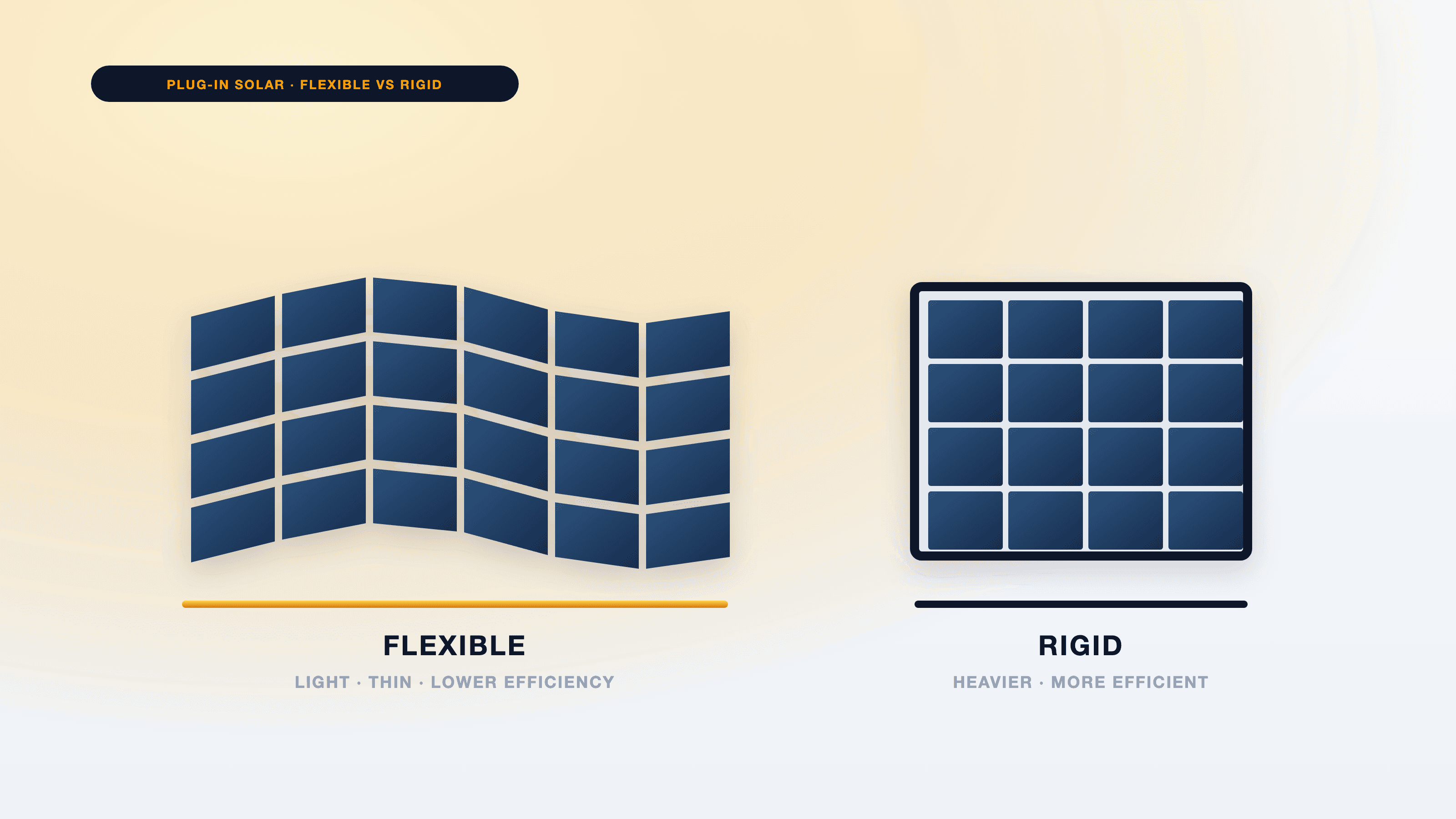
Flexible vs rigid plug-in panels
| Factor | Flexible (Lionshee) | Rigid (typical retail kit) |
|---|---|---|
| Weight per panel | 2.6kg | Heavier glass-and-frame panels |
| Efficiency | 17.55% | Around 23% on modern modules |
| Space for the same power | More surface area | Less |
| Expected lifespan | Generally shorter, per the report | Longer |
| Degradation data | No annual figure published | Usually published |
The report sums up the trade-off as efficiency and open questions over long-term durability, and says flexible panels "generally have a shorter expected lifespan" than rigid ones. Lionshee reportedly claims over 80% of output after 25 years, but the report could not find a published annual degradation figure, and we have not verified that datasheet claim. Treat it as unproven.
Who might choose it, and who should not
It could suit a site where weight is the problem: a light structure, a balcony or outbuilding that cannot take heavy rigid panels. The report calls them potentially suitable for places where heavier panels would be impractical.
It is less obvious for anyone with plenty of space and a sturdy mounting point. Rigid kits convert more sunlight per square metre and are expected to last longer. Our look at plug-in solar at Argos and Screwfix compares the rigid options on sale, and the Octopus plug-in solar review covers another kit.
What the payback could look like
This is our own arithmetic, not a manufacturer claim. At the Ofgem price cap electricity rate of 26.32p per kWh, £406.99 is recovered after roughly 1,550 kWh of output that you use yourself (406.99 ÷ 0.2632). Because a plug-in kit has no battery, only power used as it is generated displaces grid electricity, so a household home during the day gets more value than an empty one. Actual yield depends on orientation, shading and how the flat-mounted flexible panels are fixed.
Before you buy
- Check permissions. The government advises checking whether any are needed for your property, including from a landlord, freeholder or council, and says panels can go in "any outdoor space or on some balconies".
- Confirm the ENA listing on the official register for the exact model you are buying.
- Ask about fixing and warranty. The report does not cover mounting method or warranty terms, so read the listing and Lionshee's documentation.
- Plan to register the device if required. See our guide to registering plug-in solar.
Plug-in battery storage is not yet allowed under the current rules, and a government battery safety study is not expected to conclude until March 2028, per the same report.
FAQs
What is the Lionshee flexible plug-in solar kit?
Are flexible plug-in solar panels legal in the UK?
Are flexible solar panels worse than rigid ones?
How much does a flexible plug-in solar kit cost?
Sources — verified 9 November 2026
- Plug-in Solar Calculator, “The Plug-in Solar Report: 8 November 2026” — www.pluginsolarcalculator.com
- Plug-In Solar, Explained, “ENA Register: every plug-in solar device listed” — www.pluginsolarexplained.co.uk
- legislation.gov.uk, “SI 2026/848: Plugs and Sockets etc. (Safety) Regulations 1994 and Electricity Safety, Quality and Continuity Regulations 2002 (Amendment) Regulations 2026” — www.legislation.gov.uk
- GOV.UK (DESNZ), “Households can save as plug-in solar panels come to market” — www.gov.uk
- UKEM, “Energy Price Cap October 2026: Up 4% to £1,723” — www.ukem.co.uk

About the author
Sepehr
Solar specialist & co-founder, Smart Solar Homes
Solar specialist and co-founder of Smart Solar Homes, which works with MCS-certified UK installer partners. I write all the guides and reviews here; the aim is straight-talking education the industry rarely provides.
Citing this page? Please use a dofollow link back to the original article — it helps us keep the data on this page accurate and up to date.
Browse Solar Panels on Smart Solar Homes


Want to compare these side by side? Use the compare tool →
Or browse all Solar Panels on Smart Solar Homes.
Related reading
More on solar panels from the editorial team.


Find installers near you
MCS-certified solar installers covering these areas.