Thin-Film Solar Panels UK: What They Are and Who They Suit

Written and reviewed by Sepehr. See our editorial policy.
Ask a solar installer to quote you thin-film panels for your UK roof and you will almost certainly be told they do not stock them. Yet thin-film solar technology is far from a niche curiosity: it powers the solar roof tiles on heritage buildings, clads commercial facades, and sits on the curved surfaces of campervans, boats, and flat industrial roofs across the country. Understanding what thin-film panels are — and more importantly where they do and do not make sense — helps you read the market clearly and ask better questions when planning your own installation.
What makes a solar panel “thin-film”?
Thin-film panels are made by depositing one or more very thin layers of photovoltaic material onto a substrate — typically glass, metal foil, or a flexible plastic film. The active layer is typically just 1–10 micrometres thick, compared with the 180–200 micrometre wafer used in a standard crystalline silicon panel. The result is a panel that is lighter, potentially flexible, and (in some manufacturing processes) cheaper to produce at scale.
This is quite different from how standard monocrystalline or polycrystalline panels are made. Crystalline silicon panels are sliced from solid ingots; thin-film materials are essentially “painted” onto their substrate in a vacuum deposition process. The trade-off is efficiency: thin-film cells absorb light less effectively per unit area, so you need more surface to generate the same power output.
The three main thin-film technologies
1. Amorphous silicon (a-Si)
Amorphous silicon panels are the lowest-efficiency and most widely recognised thin-film type, with commercial module efficiencies of around 6–8%. Unlike crystalline silicon, the atoms in a-Si have no long-range order — which reduces efficiency but also means the panels can be deposited onto flexible substrates at low temperatures. You will find a-Si in small consumer products such as solar-powered calculators, garden lights, and rucksack charging patches rather than on residential roofs. Their main advantage is very low light performance: the high shunt resistance of amorphous silicon means they continue generating useful current even in very dim conditions, which is why they work well in indoor or low-irradiance applications.
2. Cadmium telluride (CdTe)
CdTe is the commercially dominant thin-film technology worldwide, used at utility scale primarily by First Solar, which holds the CdTe cell efficiency record at 22.1% in a laboratory setting. Commercial modules typically achieve 17–20% in production, competitive with mid-range crystalline panels. CdTe is the only thin-film technology that has achieved lower costs per watt than conventional crystalline silicon at multi-megawatt scale, largely because the manufacturing process involves fewer high-temperature steps. In the UK, CdTe is almost entirely absent from the residential market — it dominates large ground-mount and commercial rooftop projects, and you are very unlikely to be offered it by a domestic installer.
One consideration worth noting: cadmium is a toxic heavy metal. Within the stable semiconductor compound cadmium telluride, it is largely inert, and the total cadmium content per panel is less than 0.1% by weight. However, disposal at end of life does require responsible handling. First Solar operates a take-back and recycling programme for its modules. If you ever consider CdTe panels for a commercial project, confirm that the supplier offers a certified end-of-life recycling route before signing a contract.
3. Copper indium gallium selenide (CIGS)
CIGS panels offer the best efficiency of any thin-film technology, with commercial modules achieving 15–20% — overlapping the lower end of mainstream monocrystalline silicon performance. CIGS can be deposited onto flexible substrates including thin metal foils, making it the thin-film technology most applicable to residential BIPV (building-integrated photovoltaics). Manufacturers such as MiaSolé and Solar Frontier have produced flexible CIGS laminates for curved or irregular surfaces. In the UK, CIGS is available from specialist suppliers — including at least one UK manufacturer (MIPV in South Wales) producing CIGS panels for residential, marine, and automotive use — though it remains a niche product compared with crystalline silicon.
How thin-film performs in UK conditions
The UK climate creates two specific performance considerations that tend to favour thin-film over crystalline silicon in the right context.
Diffuse and low-angle light. On overcast days — the majority of UK winter days — solar irradiance arrives diffusely from a wide portion of the sky rather than as direct sunlight. CIGS and CdTe thin-film panels have a broader spectral response and higher shunt resistance than crystalline silicon, which gives them better relative performance in low-irradiance conditions. Independent tests of CIS (copper indium selenide) panels showed higher energy yield compared with crystalline equivalents in lower irradiation levels, making them well suited to UK conditions.
Temperature coefficient. Solar panels lose efficiency as they heat up. Crystalline silicon panels typically have a temperature coefficient of around −0.30% to −0.50% °C, meaning a 25 °C rise above the standard test temperature cuts output by up to 12.5%. Thin-film panels have a significantly lower temperature coefficient — around −0.17% °C in published data — so they maintain proportionally more of their rated output on hot sunny days. In a UK summer this effect is modest, but it is a real advantage for any south-facing commercial roof that can reach 55–70 °C on a clear July afternoon.
Neither advantage is large enough to make thin-film the default residential choice. A modern TOPCon monocrystalline panel delivering 22% efficiency with an all-black aesthetic will outperform most thin-film options on a standard pitched UK roof. But the temperature and diffuse-light advantages do matter in specific scenarios.
When thin-film makes sense for a UK home
BIPV: solar roof tiles and building cladding
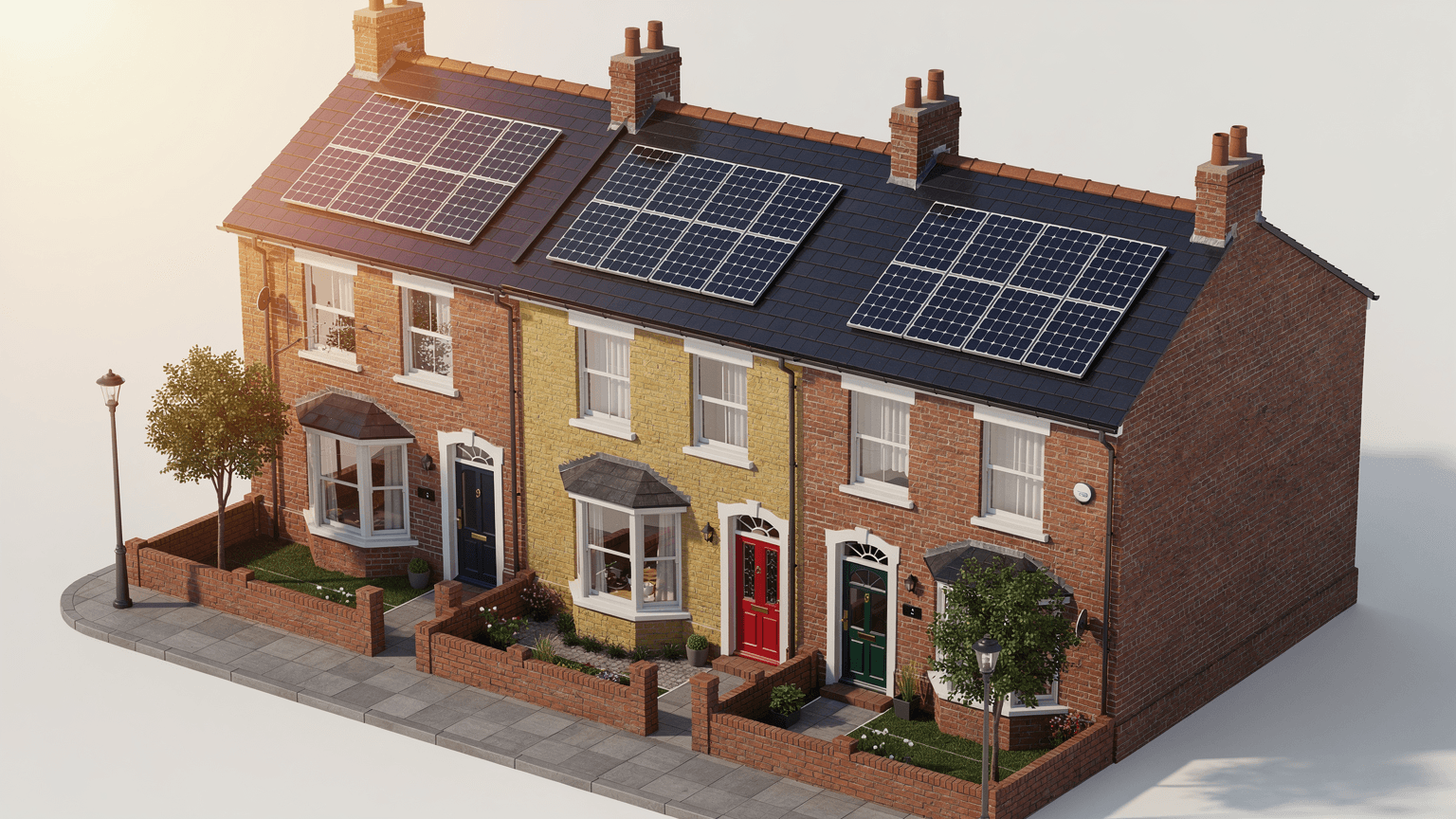
Building-integrated photovoltaics (BIPV) is where thin-film genuinely excels. BIPV products — solar roof tiles, curved facade panels, transparent glazing with embedded PV — replace conventional building materials rather than sitting on top of them. This integration is aesthetically critical for heritage properties: Historic England's guidance confirms that consent is required for any PV installation on a listed building or scheduled monument, and that BIPV products designed to blend with existing materials stand a much better chance of gaining approval than conventional rack-mounted panels. Thin-film laminates can be produced in terracotta, green, or grey tones to match traditional roofing materials, enabling solar generation that a planning officer would accept where a standard panel would not.
Flat roofs and irregular surfaces
Flexible CIGS laminates can be bonded directly to a flat or gently curved roof membrane without the penetrations, rails, and ballast required for rack-mounted crystalline panels. This reduces wind loading, avoids roof warranty complications, and is especially practical on industrial or commercial flat roofs. For very flat pitches where an aluminium-framed panel would need to be tilted — adding weight and wind sail — a lightweight adhesive-mounted thin-film product can be a practical solution.
Conservation areas and restricted sites
Even outside listed-building consent, local planning authorities in conservation areas, national parks, and areas of outstanding natural beauty (AONB) frequently require solar installations to be “unobtrusive.” Thin-film solar slates and tiles that closely match the existing roofing material are more likely to gain approval than a conventional panel array on a street-facing slope. If you are in a restricted area and aesthetics are the constraint, exploring BIPV thin-film products is worth a conversation with your local planning department before approaching a standard installer.
Certifications to look for
All thin-film panels sold for UK grid-connected residential or commercial use should carry IEC 61215 certification (which since 2016 covers all terrestrial PV technologies including CdTe, CIGS, and a-Si, replacing the older dedicated IEC 61646 thin-film standard). The MCS product certification scheme (MCS 005) also requires thin-film modules to be assessed against BS EN 61215 or BS EN 61646 before they can be used in a Microgeneration Certification Scheme-eligible installation. If a product lacks these certifications, you will not be able to claim the Smart Export Guarantee tariff for exported electricity, and your installer may not be able to guarantee workmanship under the MCS framework.
Thin-film vs crystalline: the honest comparison
For the overwhelming majority of UK homeowners with a pitched roof and no planning constraints, standard monocrystalline panels remain the right choice. They deliver higher efficiency per square metre, are widely available from MCS-certified installers, carry strong manufacturer warranties (typically 25–30 years), and have a long track record of UK residential performance. The full picture of installed costs and output is covered in our solar panel cost guide.
Thin-film becomes worth investigating when one or more of the following apply: your roof is curved, irregular, or flat and unsuitable for rack-mounted panels; you are in a conservation area or have a listed building where aesthetics are a planning constraint; or you are integrating solar into a new build or renovation as a building material rather than as an add-on. In those scenarios, CIGS or solar-tile BIPV products deserve a place on your shortlist alongside the crystalline options.
FAQs
Can I buy thin-film solar panels for my house in the UK?
Are thin-film solar panels less efficient than normal panels?
Do thin-film panels work better than crystalline panels in cloudy UK weather?
When is thin-film solar worth it for a UK home?
Do thin-film panels need certification to qualify for the Smart Export Guarantee?
Sources — verified 8 June 2026
- Historic England — Consents and Permissions for PV Systems — historicengland.org.uk
- Historic England — Installing PV Arrays on Buildings — historicengland.org.uk
- US Department of Energy — Cadmium Telluride Photovoltaics Perspective Paper — www.energy.gov
- BBA Certs — Important Changes to the MCS 005 Scheme — www.bbacerts.co.uk
- Sinovoltaics — IEC 61215 and IEC 61646 PV module certifications explained — sinovoltaics.com
- Spirit Energy — Thin Film Solar Panels knowledge base — www.spiritenergy.co.uk
- EOS Solar Solutions — Complete Guide to CIGS Solar Panels — www.eossolarsolutions.co.uk

About the author
Sepehr
Solar specialist & co-founder, Smart Solar Homes
Solar specialist and co-founder of Smart Solar Homes, which works with MCS-certified UK installer partners. I write all the guides and reviews here; the aim is straight-talking education the industry rarely provides.
Citing this page? Please use a dofollow link back to the original article — it helps us keep the data on this page accurate and up to date.
Browse Solar Panels on Smart Solar Homes


Want to compare these side by side? Use the compare tool →
Or browse all Solar Panels on Smart Solar Homes.
Related reading
More on solar panels from the editorial team.
Find installers near you
MCS-certified solar installers covering these areas.