Solar Panels on a Garage Roof: UK Rules, Weight & Wiring

Written and reviewed by Sepehr. See our editorial policy.
Putting solar panels on a garage roof is one of those ideas that sounds obvious and turns out to have a few more moving parts than people expect. A garage roof is often the sunniest spare surface a home has, it keeps panels off the main house, and — neatly — the car that could charge from that solar usually sits directly underneath. The question is rarely whether you can; it is whether your particular garage roof can take the weight, clear the planning rules, and be wired back to the house without the cost running away. This guide walks through each of those in turn.
The short version: most garages are fine, but three things decide it — the roof structure, whether the roof contains asbestos, and the distance back to your consumer unit. Get those right and a garage array behaves just like any other domestic solar install.
Will the garage roof take the weight?
This is the first thing a good installer checks, because garages are built lighter than houses. A solar array is not heavy in absolute terms — the panels plus mounting add roughly 10–20 kg per square metre spread across the roof — but a garage often has shallower rafters, longer unsupported spans, or a flat felt deck that was never designed with an extra load in mind. A tiled house roof usually shrugs this off; a flat or lightweight garage roof is exactly the case most likely to need a proper structural check.
Under the MCS standard that accredited installers work to, the mounting has to be specified for wind and snow loading and the structure confirmed as adequate before anything goes up. On a garage that means an honest look at the rafters, and on a flat roof it can mean a structural engineer signing off the combined weight of the array and its ballast. This is routine work, not a red flag — but it is not optional, and an installer who skips it is one to avoid.
Flat roof or pitched? It changes the mounting
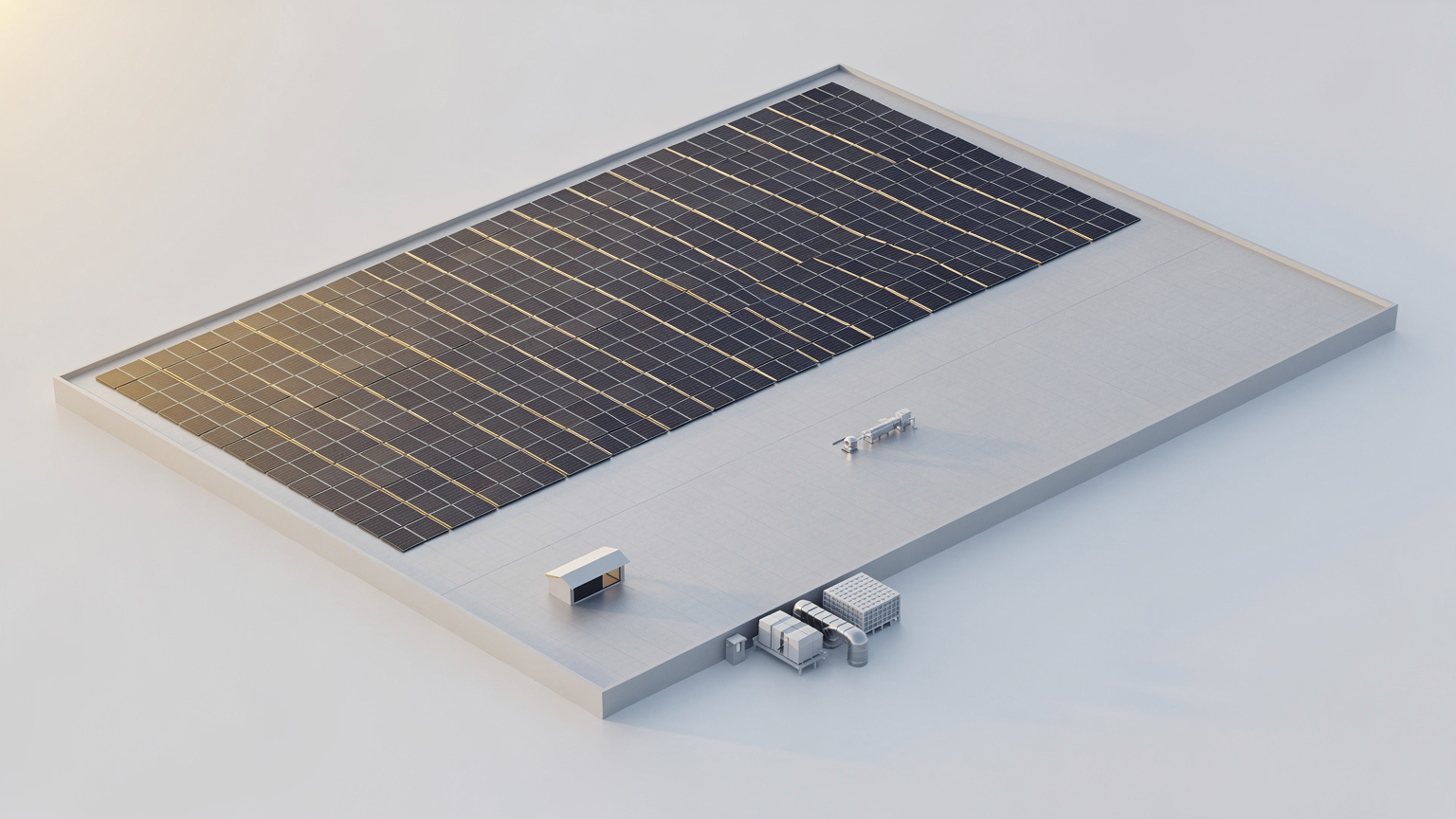
A pitched garage roof is mounted much like a house roof: rails fixed to the rafters, panels clamped on, following the existing slope. A flat garage roof — very common on single garages — is different. Panels there usually sit on a ballasted, non-penetrating frame: the mounting is weighted down with blocks rather than bolted through the waterproof membrane, so you avoid creating new leak points. The frames tilt the panels up to a shallow angle, commonly around 10–15 degrees, which packs more in and presents less area to the wind.
Wind uplift, not weight, is the main design driver on a flat roof, so ballast is concentrated at the edges and corners and panels are usually set back from the roof edge. Drainage matters too — the frame must not dam up the roof and cause ponding. If a flat garage roof is your only option, our guide to flat-roof solar panels covers the south-versus-east–west layout decision in detail.
Do you need planning permission?
In England, solar on a garage is normally permitted development, so no planning application is needed. The rules treat a garage as “a building within the curtilage of a dwellinghouse,” which sits under the same permitted-development class as panels on the house itself, with these conditions: the equipment must not protrude more than 0.2 metres beyond the roof slope or wall, and must not sit higher than the highest part of the roof (excluding the chimney). On a flat garage roof the equivalent limit is that the panels must not stand more than 0.6 metres above the highest part of the roof.
The usual exceptions apply. If your house is listed, a garage in its grounds is taken out of permitted development altogether and you will need listed building consent. The same permitted development rules and exceptions apply to solar on a garden shed — see our guide to solar panels on a shed. In a conservation area the panels must not go on a wall that fronts a highway, and a flat-roof install on protected land needs prior approval from the council first. Free-standing panels on a frame beside the garage — rather than fixed to it — count as “stand-alone” solar instead, which has its own limits (one installation, no more than 4 metres high, set back at least 5 metres from the boundary, and up to 9 square metres of panel). The rules differ in Scotland, Wales and Northern Ireland, so always confirm your own case with the local planning authority. Our wider guide to solar panel planning permission has the full picture.
The asbestos catch on older garages
Plenty of garages built before 2000 have asbestos-cement roof sheeting — the corrugated grey panels are a giveaway. This does not rule out solar, but it changes the job. Drilling intact asbestos cement is classed by the HSE as non-licensed work, which means no licence and (for a domestic garage) no notification is needed, provided it is properly controlled: wet the material, use hand tools or low-speed drilling rather than high-speed power tools that throw up dust, and seal the drilled edges afterwards.
In practice, many installers would rather not drill an asbestos roof at all, and will suggest having the sheeting removed or over-clad before fitting solar — partly for safety, partly because cutting or breaking up the sheets is a bigger job that crosses into more tightly regulated territory. If you suspect asbestos, get it identified before booking the install; it is the single most common reason a garage solar plan stalls.
Wiring a detached garage back to the house
For an attached or integral garage the wiring is straightforward — the inverter and cabling tie into the house much as a normal install. A detached garage is where costs can climb. The garage is treated as an outbuilding under the wiring regulations (BS 7671), so power generally runs back to the house on a buried steel-wire armoured (SWA) cable, often with the garage given its own small consumer unit and its own earth arrangement. Socket circuits in the garage need 30 mA RCD protection, and the whole job must be done by a registered electrician alongside the MCS-certified solar install.
The cost of that cable run depends entirely on the trenching distance and what surfaces have to be dug up and reinstated, so treat any figure as indicative — it can add several hundred pounds or more to the project. It is worth pricing early, because on a far-flung detached garage the cable run can be the difference between solar paying back comfortably and not.
Will a garage roof actually generate enough?
Two things temper expectations. Garage roofs are usually lower than the house, so an attached garage can be overshadowed by the house itself for part of the day, and detached garages are often positioned for the driveway rather than for the best aspect. Where shading is unavoidable, per-panel optimisers or microinverters limit the damage. On size, a typical single garage roof of around 15 square metres has room for roughly 6 to 9 panels — very approximately 2.7 to 4 kWp — while a double garage can take perhaps 12 to 18 panels, in the region of 5 to 8 kWp, depending on the panels used and the usable area.
The strongest case for garage solar is when it pairs with an EV charger. The car already lives there, so generation and the biggest controllable load sit under the same roof — charging the car on your own sunshine rather than buying it from the grid. Our guide to EV charging with solar explains how to line the two up.
The grid connection and getting paid
A garage array connects to the grid exactly like a roof array, because these rules follow the electricity, not the building. Your installer notifies the distribution network operator — a “fit and inform” notification (G98) for smaller single-phase systems up to 3.68 kW, or prior approval (G99) above that. Our explainer on the DNO application for solar covers when each applies.
Provided the work is MCS-certified, you can be paid for the surplus you export through the Smart Export Guarantee, just as with house-mounted panels. The economics, including current export rates and how a battery changes the sums, sit in our solar panel cost and savings guide.
Bottom line
Solar panels on a garage roof are well worth considering, especially if you drive an EV or the house roof is shaded or facing the wrong way. Just have the three decisive questions answered before you commit: can the roof carry the load, is there asbestos to deal with, and — if it is detached — how far is the cable run? Settle those and a garage becomes one of the most useful square metres of solar real estate you own.
FAQs
Can a garage roof take the weight of solar panels?
Do I need planning permission for solar panels on a garage?
How many solar panels fit on a garage roof?
Can you put solar panels on an asbestos garage roof?
Is solar on a detached garage worth it?
Sources — verified 15 June 2026
- legislation.gov.uk, “Town and Country Planning (GPDO) 2015, Schedule 2, Part 14 — solar PV” — www.legislation.gov.uk
- Planning Portal, “Solar panels mounted on a house or a building” — www.planningportal.co.uk
- Planning Portal, “Stand-alone solar equipment within the grounds of a house” — www.planningportal.co.uk
- HSE, “Non-licensed asbestos work” — www.hse.gov.uk
- HSE, “Asbestos essentials task sheets” — www.hse.gov.uk
- MCS, “Notifying DNOs (G98/G99)” — mcscertified.com
- Ofgem, “About the Smart Export Guarantee (SEG)” — www.ofgem.gov.uk
- Energy Saving Trust, “Solar panels” — energysavingtrust.org.uk

About the author
Sepehr
Solar specialist & co-founder, Smart Solar Homes
Solar specialist and co-founder of Smart Solar Homes, which works with MCS-certified UK installer partners. I write all the guides and reviews here; the aim is straight-talking education the industry rarely provides.
Citing this page? Please use a dofollow link back to the original article — it helps us keep the data on this page accurate and up to date.
Browse Solar Panels on Smart Solar Homes


Want to compare these side by side? Use the compare tool →
Or browse all Solar Panels on Smart Solar Homes.
Related reading
More on solar panels from the editorial team.

Find installers near you
MCS-certified solar installers covering these areas.