Solar Panels in a Conservation Area: What the Rules Actually Say

Written and reviewed by Sepehr. See our editorial policy.
There are more than 9,900 conservation areas in England alone, covering roughly one in ten properties — and for many homeowners in those areas, the question of going solar triggers an immediate worry: do I need planning permission? The short answer is usually no. Permitted development rights cover most rooftop solar in conservation areas, but there are specific restrictions that catch people out. This guide explains exactly where the line sits, what to do if your installation falls outside permitted development, and how rules differ in Scotland and Wales.
Permitted development: what it means for conservation areas
Permitted development (PD) is a standing grant of planning permission built into the Town and Country Planning (General Permitted Development) (England) Order 2015 (GPDO). Under Part 14, Class A, rooftop solar panels on a dwelling are permitted development — including in conservation areas — provided every condition is met. The key conditions for pitched roofs are:
- Panels must not protrude more than 200mm (0.2 metres) beyond the plane of the roof slope (measured perpendicularly).
- No part of the installation may be higher than the highest part of the roof (excluding chimneys).
- Panels must not be installed on a wall or roof slope that fronts a highway — this is the key conservation area restriction.
- The visual impact of the installation must be minimised so far as practicable.
- Equipment must be removed when no longer needed.
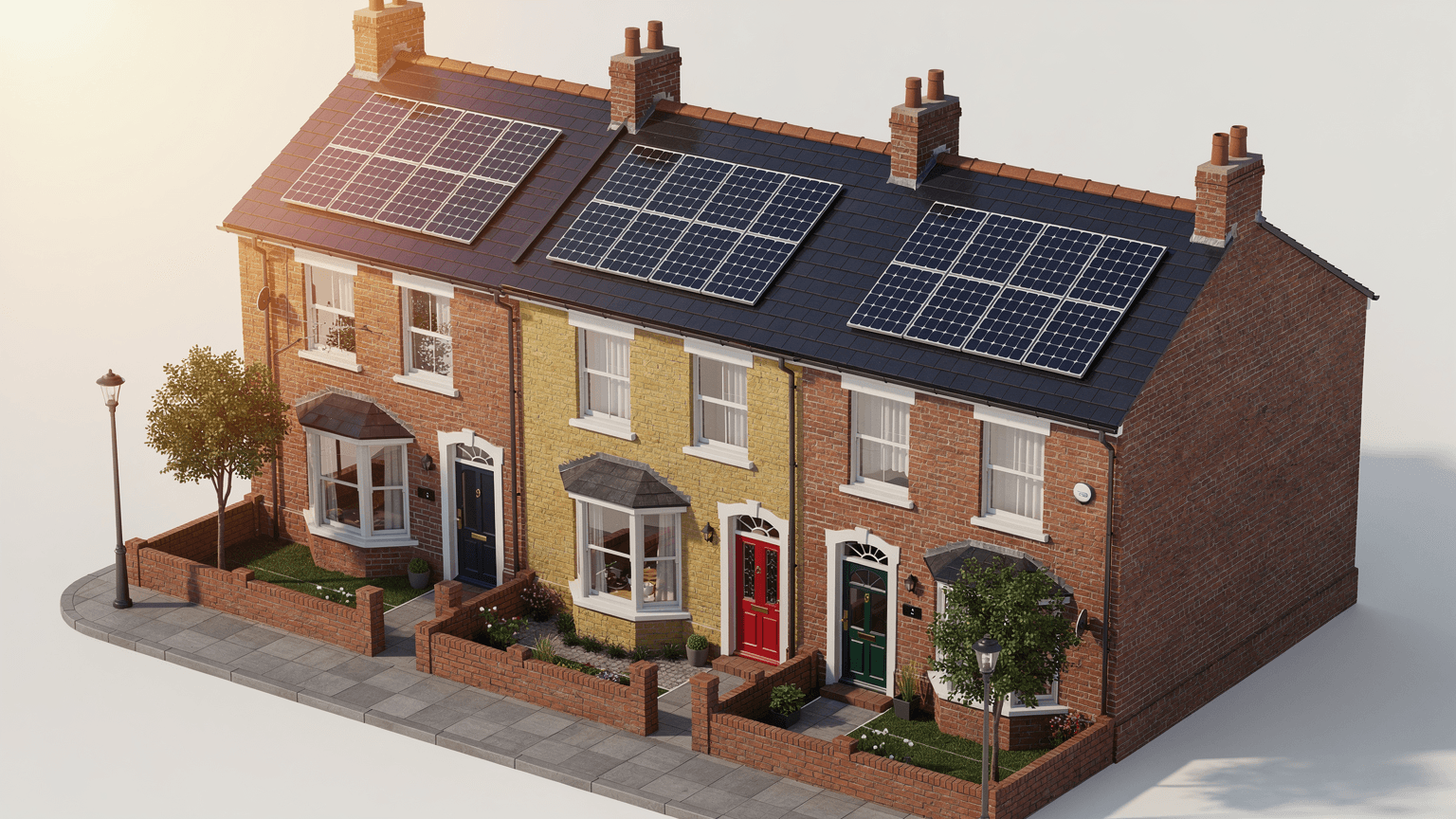
The "fronts a highway" condition is what matters in practice. Your rear roof slope, a side slope that does not face a road, and any roof on a rear outbuilding will typically fall within PD. Your front roof slope, or any wall visible from a public road, does not.
Flat roofs and prior approval
Flat-roof installations in conservation areas follow a slightly different rule. Panels on a flat roof are permitted development generally, but if the property sits on designated land — which includes conservation areas, National Parks, Areas of Outstanding Natural Beauty, and World Heritage Sites — the developer must first apply to the local planning authority (LPA) for prior approval. The LPA assesses the impact of the panels' appearance on the designated area. Prior approval is not the same as full planning permission; the process is lighter, typically quicker, and fees are lower. If the LPA does not respond within the statutory period, prior approval is deemed granted.
What "fronts a highway" actually means
The prohibition on panels fronting a highway is narrower than it sounds. A "highway" in planning terms means a public road, footpath, or right of way — not simply any area visible from the street. A roof slope that faces directly onto a public road is clearly caught. A side slope visible from a road at an angle is a grey area; some LPAs take a strict view, others do not. If you are unsure, the safest step is a quick pre-application enquiry with your LPA, or applying for a Lawful Development Certificate (LDC), which gives you legal certainty that your installation is PD before you proceed. For a full walkthrough of when planning permission is needed for solar panels, including the dimensional rules, see our dedicated guide.
Article 4 Directions — the hidden catch
Local planning authorities can remove or restrict PD rights through an Article 4 Direction (A4D). These are most common in conservation areas with especially sensitive historic character — parts of Bath, Edinburgh, and many London conservation areas have them. Where an A4D is in place, you may need full planning permission even for a rear-slope installation that would otherwise be PD. There is no national register of all active A4Ds; the only reliable check is to contact your LPA directly or search their planning register. Many councils publish interactive maps. Do this before commissioning a survey.
Listed buildings — separate rules apply
If your home is a listed building, PD rights for solar do not apply at all, regardless of whether you are also in a conservation area. You will need both full planning permission and Listed Building Consent from the LPA. The consent process considers the impact on the building's special architectural or historic interest. Consent can and is sometimes granted — particularly when panels are sited on a non-principal rear elevation, use black or dark framing to minimise contrast, and cause no structural damage — but it is not guaranteed and specialist advice from a conservation architect or planning consultant is strongly recommended. Solar roof tiles, which sit flush with the roof plane, can be easier to justify visually; see our guide to solar roof tiles in the UK for product options and planning considerations.
Ground-mounted panels in conservation areas
Ground-mounted systems in conservation areas face tighter rules. Under PD, a ground-mounted array within a domestic curtilage must be a single panel, must not be within 5 metres of the property boundary, and must not exceed 9 square metres in panel area or 4 metres in height. In a conservation area, any ground-mounted installation that is nearer to the highway than the dwelling itself requires prior approval from the LPA, even if it otherwise meets the PD conditions.
Scotland and Wales — devolved rules
Scotland has its own PD framework and has generally liberalised its rules. As of 2024, the Scottish Government removed the 50 kW generation limit for rooftop solar on domestic buildings, meaning most residential roof installations qualify as PD regardless of system size. In conservation areas, however, panels remain restricted from principal elevations or side elevations facing a road — the same broad principle as in England. Listed buildings in Scotland require Listed Building Consent regardless of panel position. World Heritage Sites (Edinburgh Old Town and New Town; New Lanark) require full planning permission.
Wales broadly mirrors the English framework. In a conservation area, panels on principal or side elevation walls that are visible from the highway require consent. Rear-facing roof installations are generally PD. Listed buildings require both planning permission and Listed Building Consent.
How to strengthen a planning application when PD does not apply
When a full application or listed building consent is required, the following factors improve the likelihood of approval:
- Position panels on the least visible elevation — rear slopes, rear outbuildings, or inner courtyard roofs where available.
- Use black or dark-framed panels and frameless or all-black modules where budget allows — they read as less intrusive against dark slate or clay tile roofs.
- Keep the installation reversible — no permanent structural alterations to the fabric of the building.
- Submit a design and access statement explaining how the installation respects the character and appearance of the conservation area.
- Consider solar roof tiles for street-facing slopes — products like the Marley SolarTile sit flush with the roof plane and are increasingly accepted in conservation area applications where standard raised panels would not be.
- Talk to a conservation officer early — most LPAs offer pre-application advice (fees apply) and an informal conversation can prevent a costly refusal.
Practical checklist before you proceed
- Confirm whether your property is in a conservation area (check your LPA's mapping tool or planning.data.gov.uk).
- Check for any Article 4 Directions covering your address — contact the LPA or search the planning register.
- Check whether the building is listed (Historic England's Listed Buildings register, or Cadw/Historic Environment Scotland for Wales/Scotland).
- Identify which roof slopes or walls your installer proposes to use, and whether any front the highway.
- For flat roofs in a conservation area, submit a prior approval application before proceeding.
- If in doubt, apply for a Lawful Development Certificate — it costs less than a full planning application and removes legal uncertainty.
Conservation area requirements often require sympathetic design — see our guide to aesthetics requirements in conservation areas.
FAQs
Do I need planning permission for solar panels in a conservation area?
Can I put solar panels on a front-facing roof in a conservation area?
What is an Article 4 Direction and how does it affect solar panels?
Can I install solar panels on a listed building in a conservation area?
How far can solar panels stick out from the roof under permitted development?
Sources — verified 7 June 2026
- Town and Country Planning (General Permitted Development) (England) Order 2015, Part 14 — www.legislation.gov.uk
- Living in a Conservation Area — Historic England — historicengland.org.uk
- Designated Assets Indicator Data (9,907 conservation areas in England, 2024) — Historic England Heritage Counts — historicengland.org.uk
- Planning permission: solar panels — www.gov.wales
- Review of Permitted Development Rights Phase 3 (domestic renewables, Scotland) — www.gov.scot
- Solar panels planning guidance — Planning Portal — www.planningportal.co.uk

About the author
Sepehr
Solar specialist & co-founder, Smart Solar Homes
Solar specialist and co-founder of Smart Solar Homes, which works with MCS-certified UK installer partners. I write all the guides and reviews here; the aim is straight-talking education the industry rarely provides.
Citing this page? Please use a dofollow link back to the original article — it helps us keep the data on this page accurate and up to date.
Browse Solar Panels on Smart Solar Homes


Want to compare these side by side? Use the compare tool →
Or browse all Solar Panels on Smart Solar Homes.
Related reading
More on solar panels from the editorial team.
Find installers near you
MCS-certified solar installers covering these areas.