Solar Panels and Aesthetics: Which Options Blend in Best on a UK Home

Written and reviewed by Sepehr. See our editorial policy.
Solar panels are now a common sight on UK streets, but the technology has moved well beyond the chunky blue modules of the 2010s. Today's homeowners can choose sleek all-black panels, low-profile in-roof systems, or fully integrated solar tiles that are nearly indistinguishable from standard roofing. Understanding the aesthetic trade-offs — and the planning rules that govern them — helps you pick an installation that performs well and looks the part on your home.
All-Black Panels vs Standard Blue-Framed: What Is the Actual Difference?
Standard (blue/silver) panels use polycrystalline silicon cells with a white backsheet and a silver aluminium frame. The white spaces between cells create a visible grid pattern, and in direct sunlight the cells shift between blue and purple. This was the default UK aesthetic for over a decade, but polycrystalline production has largely been discontinued by major manufacturers as of 2025 — so if you are getting a new installation, you are almost certainly receiving monocrystalline panels regardless.
All-black (full-black) panels use monocrystalline cells, a black backsheet, and a black anodised aluminium frame. The result is a near-uniform dark surface with minimal visual grid lines. On a dark grey slate or concrete tile roof — the most common UK roof covering — all-black panels integrate considerably better: the frame disappears against the roof, and the panel surface reads as a deep, clean rectangle rather than a patchwork.
The trade-off is cost and a minor efficiency penalty. All-black panels typically carry a 10–20% price premium over otherwise equivalent white-backsheet monocrystalline panels, according to multiple UK installers. The black backsheet absorbs slightly more heat, which can reduce output by a small margin on very hot days — but in the UK climate, where summer temperatures rarely exceed 30 °C, this effect is negligible for most households. If you want to compare panel specifications in detail, our guide to the best solar panels in the UK for 2026 covers efficiency ratings and manufacturer warranties side by side.
Black Frame vs Silver Frame: The Cheaper Compromise
A middle-ground option is a black-framed panel with a white backsheet. The frame disappears against a dark roof in the same way as a full-black panel, but the white backsheet keeps cell-to-cell contrast visible up close. From street level — which is how most passersby and neighbours actually see your roof — the difference between a black-framed white-backsheet panel and a fully black panel is very small. Black-framed panels carry a smaller price premium (typically 5–10%) and are offered as standard by most reputable UK brands including REC, Q CELLS, and Longi.
On lighter roofs (brown interlocking tiles, red clay, or golden stone), neither black nor silver frames blend in perfectly. In these cases, the visual priority shifts to panel layout — neat, symmetrical rows with consistent spacing — rather than frame colour.
In-Roof vs On-Roof Mounting: The Profile Matters
Most domestic UK solar is installed on-roof: panels sit on aluminium rails bolted through the roof tiles, raising the array roughly 80–120 mm above the roof surface. This profile is clearly visible from the side and can look industrial on period properties.
In-roof (integrated) systems replace the tiles beneath the panels entirely. The array sits flush with — or only a few millimetres proud of — the surrounding roof surface, with no visible brackets or racking. The visual result is dramatically cleaner, and local planning authorities typically view in-roof systems more favourably in conservation areas and other sensitive locations. The practical downside is cost: in-roof systems require a roofer alongside the solar installer, and the total cost is typically 20–40% higher than an equivalent on-roof installation. Ventilation under the panels is also reduced, which can marginally increase operating temperatures.
Under UK permitted development rules (The Town and Country Planning (General Permitted Development) (England) Order 2015, Schedule 2 Part 14), roof-mounted panels on a pitched roof must not protrude more than 0.2 metres beyond the plane of the roof slope, measured perpendicular to the roof surface. In-roof systems comfortably satisfy this condition; standard on-roof rails typically sit 80–120 mm (0.08–0.12 m) below the limit as well, though the profile still looks raised at close range.
Solar Tiles and Slates: Full Integration
At the premium end of the market, building-integrated photovoltaics (BIPV) replace the roof covering entirely. The main UK options are:
- Marley SolarTile: A MCS-certified concrete solar roof tile available in 335 W and 445 W versions. The tile profile matches Marley's standard Edgemere concrete interlocking tile, giving a uniform roof appearance. Marley backs the system with a 15-year guarantee. A typical 4 kW domestic system using SolarTile costs approximately £12,000–£20,000 — two to three times more than an equivalent on-roof panel installation.
- GB Sol Solar Slate: A Welsh-manufactured PV slate with a natural blue-grey appearance that closely mimics genuine Welsh slate. MCS-certified since 2018, GB Sol products are frequently cited in planning applications for conservation areas and National Parks because they satisfy the planning inspector's test of not detracting from the area's character.
- Tesla Solar Roof: Widely known but not widely available in the UK as of 2026. Tesla has concentrated its Solar Roof rollout on the US market; UK installations are rare, and whole-roof costs run to £50,000–£100,000. Not a practical mainstream option for UK homeowners at present.
The energy yield from solar tiles is generally lower per square metre than conventional panels, partly because tiles cannot be angled independently of the roof pitch. If your roof pitch is not close to the UK optimum of 30–40°, or if the roof faces anything other than due south, the output penalty compared with optimally tilted on-roof panels can be significant. For a full cost and savings comparison, see our article on solar panel costs in the UK.
Planning and Conservation Areas
For most UK homes, solar panels qualify as permitted development and require no planning application. The key conditions under Schedule 2 Part 14 of the GPDO 2015 are: panels must not protrude more than 0.2 m beyond the roof slope; no part of the array may be higher than the highest part of the existing roof (excluding chimneys); and panels must not be installed on a wall or roof slope that fronts a highway (including a road, footpath, or bridleway) if the property is in a conservation area, World Heritage Site, or Area of Outstanding Natural Beauty.
That final condition is the one that catches homeowners out. If your front roof slope faces a public road and you live in a conservation area, you will need to place panels on the rear slope or apply for full planning permission. Some conservation areas also have Article 4 Directions that remove permitted development rights entirely — always check with your local planning authority before installation. In these situations, in-roof systems and solar slates have a strong track record of gaining approval where standard on-roof arrays have been refused.
Which UK House Styles Suit Solar Best?
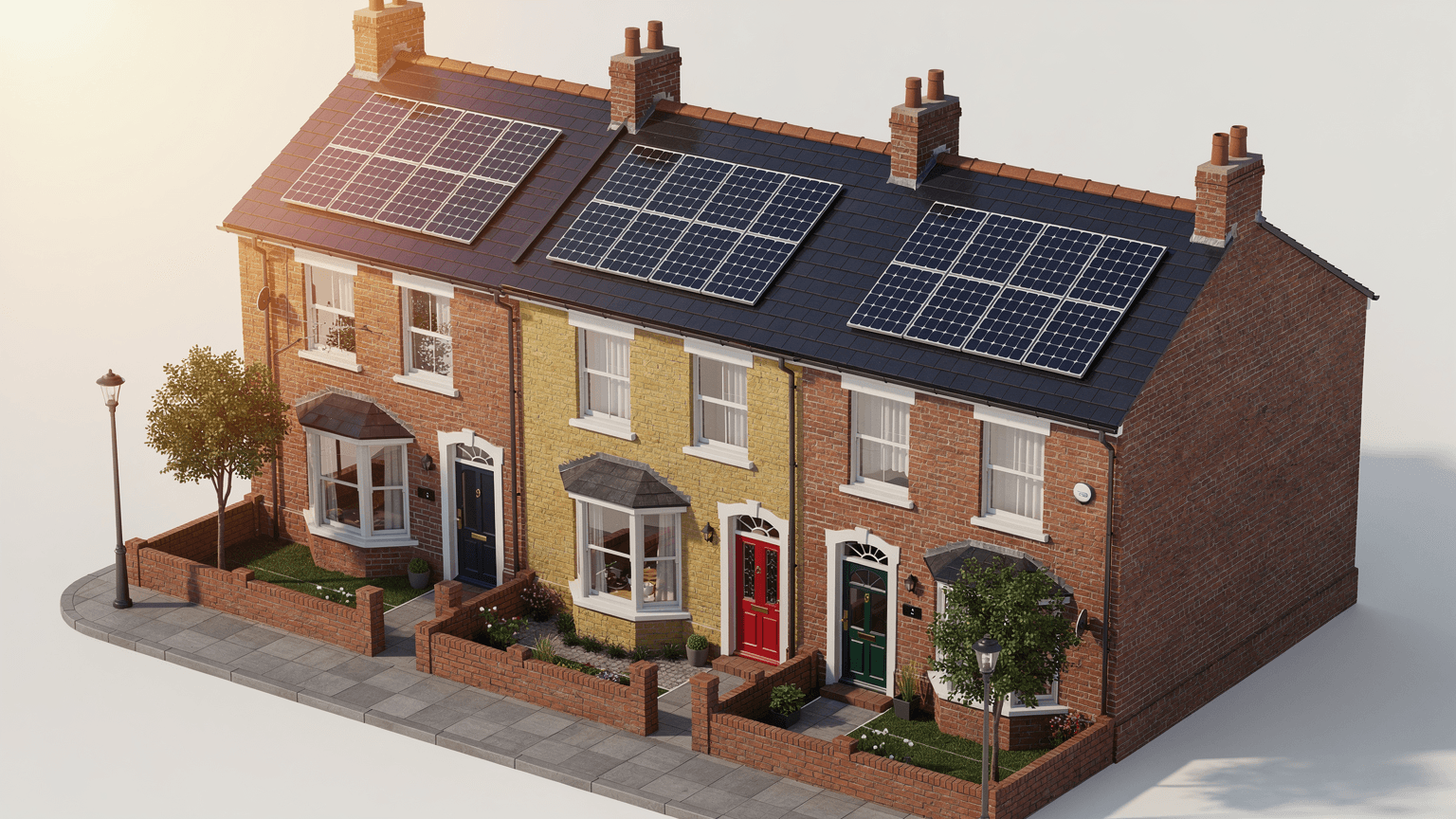
Visually, dark-roofed homes suit solar best. The typical London or South-East semi-detached with a dark grey slate or concrete tile roof is the ideal canvas for all-black panels: the array blends into the roof plane, and the home's appearance changes less than many owners expect. Period terraces with original clay plain tiles (red or orange) present more of an aesthetic challenge — here, in-roof systems or solar slates in a matching tone are worth the extra investment if kerb appeal matters.
Flat or low-pitch roofs (under 15°) are poorly suited to roof tiles or solar slates but work well with standard panels on adjustable tilted frames — these are rarely visible from street level anyway, so aesthetics are less of a concern.
A Practical Aesthetic Checklist
- Dark roof (slate, dark concrete tile): all-black or black-framed panels are a cost-effective upgrade with a clean result.
- Light or coloured tiles: consider in-roof systems or coloured solar slates to match; a well-laid on-roof system in neat rows is acceptable if budget is limited.
- Conservation area or Article 4 Direction: get in-roof or BIPV; check with your LPA before signing any contract.
- Listed building: solar is possible but requires listed building consent in addition to any planning permission — specialist advice is essential.
- New roof due anyway: BIPV tiles become far more cost-competitive when roofing costs are already being incurred.
FAQs
Do all-black solar panels cost more than standard panels?
Are in-roof solar panels worth the extra cost for looks?
Do I need planning permission for solar panels in a conservation area?
How much do solar roof tiles cost in the UK?
Which UK roof colour suits solar panels best?
Sources — verified 8 June 2026
- The Town and Country Planning (General Permitted Development) (England) Order 2015 — Schedule 2, Part 14, legislation.gov.uk — www.legislation.gov.uk
- Marley SolarTile — product page including wattage and guarantee details, Marley — www.marley.co.uk
- GB-Sol Integrated Solar Slate buyer's guide, GB Sol — gb-sol.co.uk
- DMEGC Solar, "DMEGC Solar Launches New Full Black PV Module, Balancing Performance and Reliability" — www.dmegcsolar.com
- Planning Portal — Do I need permission for solar panels in a conservation area? — interactive.planningportal.co.uk
- Solar roof tiles — Energy Saving Trust — energysavingtrust.org.uk

About the author
Sepehr
Solar specialist & co-founder, Smart Solar Homes
Solar specialist and co-founder of Smart Solar Homes, which works with MCS-certified UK installer partners. I write all the guides and reviews here; the aim is straight-talking education the industry rarely provides.
Citing this page? Please use a dofollow link back to the original article — it helps us keep the data on this page accurate and up to date.
Browse Solar Panels on Smart Solar Homes


Want to compare these side by side? Use the compare tool →
Or browse all Solar Panels on Smart Solar Homes.
Related reading
More on solar panels from the editorial team.
Find installers near you
MCS-certified solar installers covering these areas.