Solar Panel Scaffolding UK: What HSE Guidance Expects
Written and reviewed by Sepehr. See our editorial policy.
Safety guidance from the UK’s health and safety regulators is clear that solar panel installation is not short-duration work and needs scaffolding or similar equipment, with a boarded platform and full edge protection. So if a quote for a pitched-roof installation makes no mention of scaffolding, ask why. This guide sets out what the published guidance says, what it means for you as the householder, and the questions worth asking. For wider advice on choosing who does the work, see our guide to choosing a solar installer.
What does the guidance say about scaffolding for solar panels?
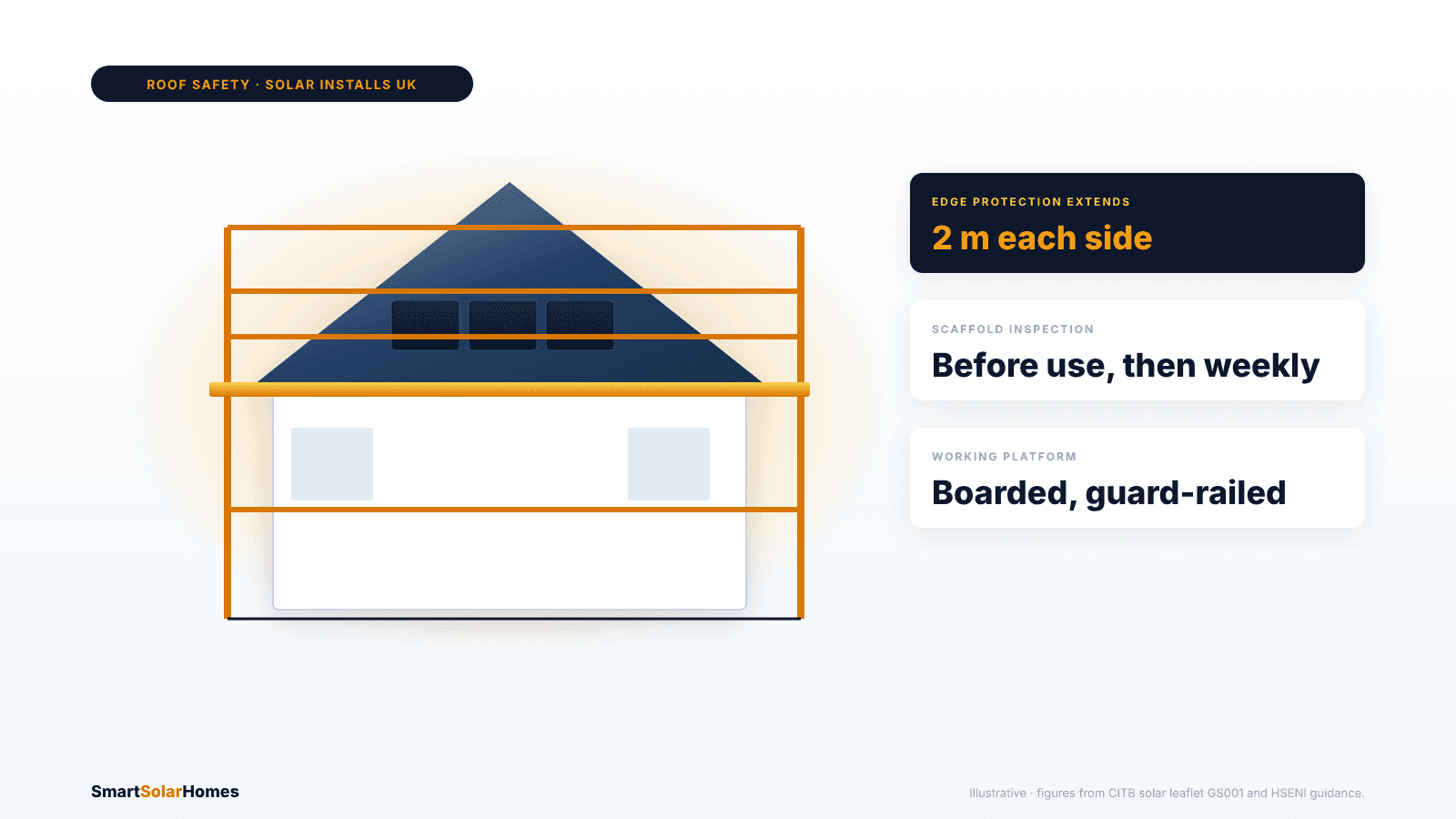
The Health and Safety Executive for Northern Ireland (HSENI) states: “solar panel installation is not short duration work and will need scaffolding or similar equipment.” Its guidance, first published in May 2014, adds that the scaffold should have a boarded working platform and full edge protection (double guard-rails and toe-boards) to stop people and tools from falling. The CITB’s solar panel installation leaflet (GS001, April 2019) says the same, and states that its content is in line with advice from the Health and Safety Executive (HSE) in Great Britain.
HSE’s roof work page says that sloping roofs require scaffolding to prevent people or materials falling from the edge, and that edge protection must be fitted to the eaves of any roof, including the rear as well as the front on terraced properties. It reserves ladders and roof ladders for work of short duration, measured in minutes. For flat roofs, it says falls from the edge can be prevented by a secure double guardrail and toeboard around the edge.
What should the scaffold look like?
The published guidance gives specific expectations for a domestic job.
- Edge protection length: along the eaves of the roof slope being worked on, extending 2m on each side beyond the area of work. If 2m is not available because the array is close to the gable end, gable end protection should be provided.
- Who builds it: a trained and competent scaffolder only, for erecting, altering or dismantling.
- Inspection: before first use, then weekly, and after anything that might have affected its safety, such as high winds.
- Debris netting: may be necessary to stop materials falling on householders or neighbours.
- Ladders: for access only, not for working from, securely tied at the top and extending at least 1m (or five rungs) past the stepping-off point.
What else does it cover besides scaffolding?
- Fragile roofs: no one should stand on unprotected fragile surfaces such as roof lights or fibre-cement sheets, or work within 2m of them without barriers.
- Lifting: panels are heavy, so the CITB leaflet calls for suitable lifting equipment such as a hoist or safety pulley fitted with an automatic brake, and checks that the platform’s safe working load is not exceeded.
- Overhead cables: the leaflet says the minimum distance from lines serving domestic properties is 1m, and suggests asking the electricity supplier about temporary sleeving if that cannot be kept.
- Electrical work: connections must be carried out by a qualified electrician.
- Roof weight: the planning questions include whether the roof can safely take the weight of the panels plus equipment and workers. See our roof structural checks guide.
Are there exceptions, such as a mobile platform?
HSENI notes that where a mobile elevating work platform (MEWP) can reach, working from a harnessed boom lift may be feasible for one or two panel jobs. HSE lists several ways to reach a roof, including scaffold towers and stair towers. Because HSENI describes installation as not short-duration work, ladders alone are not the expected method, but the guidance does not say that scaffolding is the only possible method for every job, so ask the installer what their method statement is. HSE describes a method statement as the common way to manage roof work and communicate the precautions.
Why does it matter to a homeowner?
HSE says almost one in five deaths in construction work involve roof work, and that many deaths each year involve smaller builders working on the roof of domestic dwellings. The CITB leaflet, which is aimed at people who do not directly employ the workers on their job, gives examples of prosecutions after materials fell and injured a member of the public, and after a fatal fall where no scaffolding was provided. Beyond safety, the leaflet asks installers to agree a safe access route for the occupier, keep people away from the area below the work, and make the work area child-safe at the end of the day, for example by removing or blocking ladders.
Questions to ask before you sign
- Is scaffolding included in the quote, and who supplies and inspects it?
- If not scaffolding, what is the access and edge protection method, in writing?
- How will fragile roof lights or sheets be protected?
- How will panels be lifted onto the roof?
- What is the plan for safe future access for maintenance? Our roof preparation guide and flat roof guide cover related points.
This guide summarises published guidance and is not legal advice. For the wider picture of the job, see our solar panel installation advice.
FAQs
Do solar panels need scaffolding?
Can installers just use ladders?
How far should scaffold edge protection extend?
How often should scaffolding be inspected?
Can a cherry picker replace scaffolding?
What should I check in my solar quote?
Sources — verified 23 November 2026
- HSE Northern Ireland, “Installing solar panels safely” — www.hseni.gov.uk
- HSE, “Roof work” — www.hse.gov.uk
- CITB, “Solar panel installation: what you need to know to work safely (GS001)” — www.citb.co.uk

About the author
Sepehr
Solar specialist & co-founder, Smart Solar Homes
Solar specialist and co-founder of Smart Solar Homes, which works with MCS-certified UK installer partners. I write all the guides and reviews here; the aim is straight-talking education the industry rarely provides.
Citing this page? Please use a dofollow link back to the original article — it helps us keep the data on this page accurate and up to date.
Browse Solar Panels on Smart Solar Homes


Want to compare these side by side? Use the compare tool →
Or browse all Solar Panels on Smart Solar Homes.
Related reading
More on solar panels from the editorial team.
Find installers near you
MCS-certified solar installers covering these areas.