AC Isolator for Solar UK: Hager JG232IN 32A Specs
Written and reviewed by Sepehr. See our editorial policy.
The Hager JG232IN is a 32A, two-pole, IP66 enclosed isolator of the kind often fitted on the AC output of a home solar inverter. This guide to an AC isolator for solar works through Hager’s datasheets for the JG232IN and its JG232U utility sibling, shows what the numbers do and do not tell you, and corrects a claim in our own product listing. For how the wider wiring fits together, see our solar panel installation advice.
What is the Hager JG232IN?
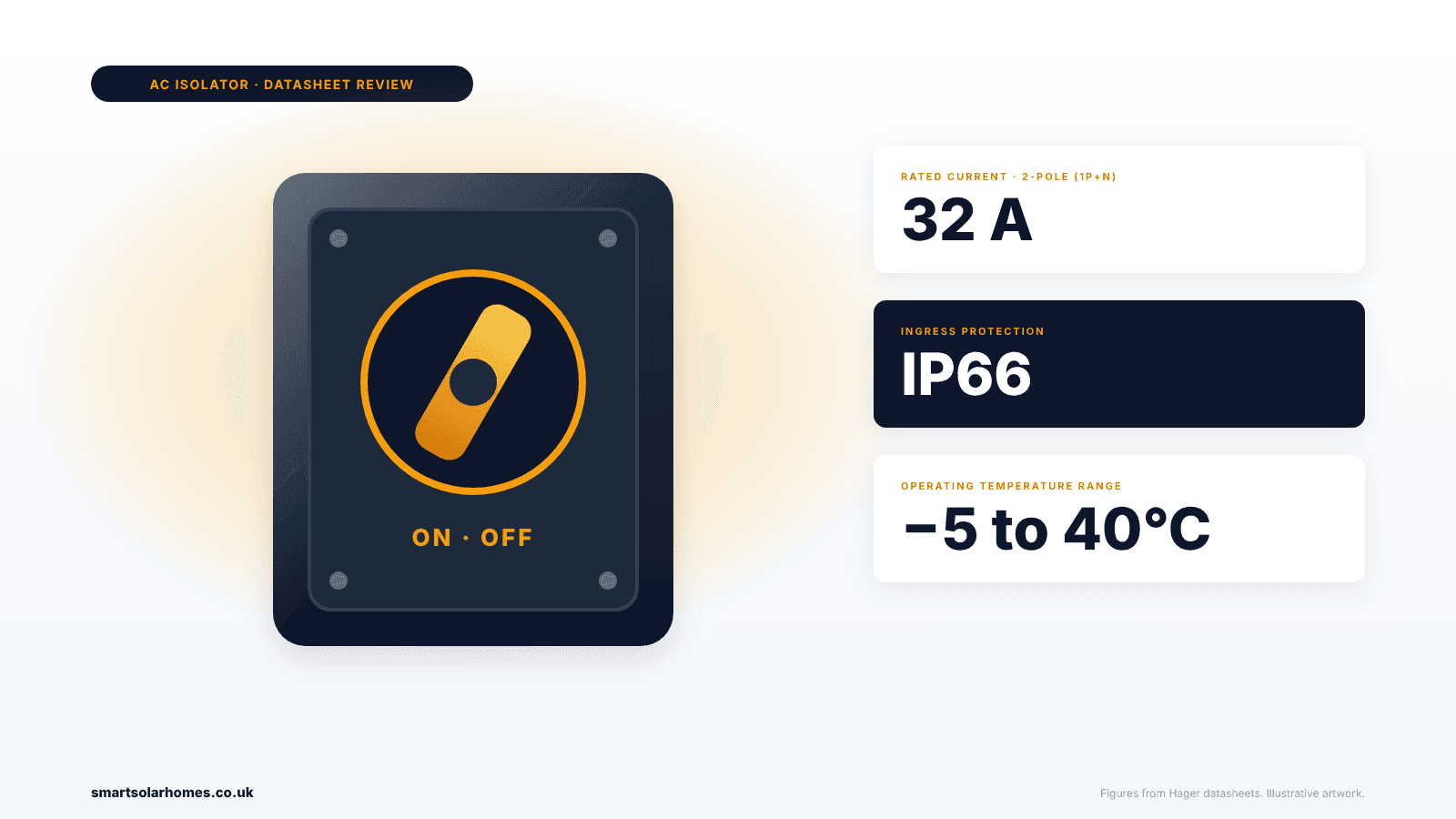
Hager lists it as an “IP66 32A 2P isolator” with two poles (1P+N), a rated current of 32A and a rated operational voltage of 250V. It is a switch for disconnecting a single-phase circuit, not a circuit breaker, so it gives no overload or fault protection. Hager’s datasheet does not mention solar panels, inverters or DC use, so any solar application is a design decision for your installer.
Datasheet specs
Figures are from Hager’s product datasheet for the JG232IN (subject to technical changes 14 November 2026).
- Ratings: 32A at AC-21, AC-22 and AC-23 category A, rated operational voltage 250V, rated insulation voltage 440V and a 50 to 60Hz frequency range.
- Fault ratings: short-circuit making capacity of 0.38kA at 240V AC to IEC 60947-3, and a short-time withstand current of 0.38kA for 1 second.
- Power: a rated operational power of 5,200W under 400V AC at AC-23.
- Enclosure: IP66 ingress protection, 170 × 84 × 87mm, halogen-free.
- Connections: screw terminals for rigid conductors of 6 to 10mm² at a nominal tightening torque of 2.5Nm.
- Operating temperature: −5°C to 40°C.
JG232IN vs JG232U
The JG232U “utility” isolator (datasheet dated 9 July 2026) shares the 32A, 2-pole, IP66 format and the same dimensions, terminals and 0.38kA fault ratings. The visible difference is the rated insulation voltage, which is 250V rather than 440V, and the JG232U sheet lists AC-21 and AC-22 category A at 32A but no AC-23 rating or operating power. Check which one your installer is specifying and that the marking on the unit matches the order.
Sizing: will 32A cover your inverter?
Dividing power by a 230V supply gives a rough current: a 3.68kW inverter is about 16A, 5kW about 22A, 6kW about 26A and 7kW about 30A. That arithmetic is ours, not Hager’s, and your installer will also consider cable size, the protective device and the inverter manufacturer’s instructions. A 32A isolator leaves headroom for most domestic single-phase inverters but is not a substitute for sizing the whole circuit. Our hybrid inverter guide and best inverters guide cover output ratings.
What to check before you buy
- Temperature: the datasheet range stops at 40°C. An enclosure fixed in direct sun, a loft or a hot plant room may run hotter than the air around it, so ask your installer about the location.
- Terminals: the sheet lists rigid conductors of 6 to 10mm² only. Check that your cable and any ferrules suit the terminal.
- Fault level: the 0.38kA short-time ratings are modest, so the isolator must sit behind a suitable protective device; this is for a qualified electrician to design.
- Regulations: whether and where a solar AC isolator is required depends on the installation and the inverter instructions. We could not confirm a specific BS 7671 clause from Hager’s datasheet, so see our BS 7671 Amendment 4 guide and ask your installer.
Our listing was overstated
Our product listing for a 32A AC isolator said it was “required by BS 7671” for the inverter AC output. Hager’s datasheet supports the 32A, 2-pole, IP66 and IEC 60947-3 figures, but nothing in it supports that regulatory claim, so we have removed that framing here. We list a 32A isolator at about £32; prices vary by supplier.
Who it suits
It suits an electrician or MCS installer who needs an enclosed 32A disconnect for a single-phase solar or battery circuit. It is not a DIY shortcut; electrical work on a consumer unit and inverter circuit should be done by a competent person, as discussed in our DIY solar installation guide. See also our surge protection guide for other protective devices, and compare quotes from an MCS-certified installer.
Our verdict
The Hager JG232IN is a sturdy, IP66-rated 32A isolator with clear ratings, but its datasheet is silent on solar use, its operating range tops out at 40°C and its fault ratings are modest. Treat it as a good component for a properly designed circuit, and ask your installer to confirm the design and location.
FAQs
What is a solar AC isolator?
What is the difference between the Hager JG232IN and JG232U?
How many amps is a 5kW inverter?
Is the Hager JG232IN a circuit breaker?
What temperature range does the Hager JG232IN handle?
Sources — verified 21 November 2026
- Hager, “Product datasheet JG232IN: IP66 32A 2P isolator (14.11.2026)” — assets.hager.com
- Hager, “Product datasheet JG232U: IP66 32A 2P utility isolator (09.07.2026)” — assets.hager.com

About the author
Sepehr
Solar specialist & co-founder, Smart Solar Homes
Solar specialist and co-founder of Smart Solar Homes, which works with MCS-certified UK installer partners. I write all the guides and reviews here; the aim is straight-talking education the industry rarely provides.
Citing this page? Please use a dofollow link back to the original article — it helps us keep the data on this page accurate and up to date.
Browse Solar Panels on Smart Solar Homes


Want to compare these side by side? Use the compare tool →
Or browse all Solar Panels on Smart Solar Homes.
Related reading
More on solar panels from the editorial team.
Find installers near you
MCS-certified solar installers covering these areas.