Solar iBoost+ Review UK: Price, Specs & vs Eddi
Written and reviewed by Sepehr. See our editorial policy.
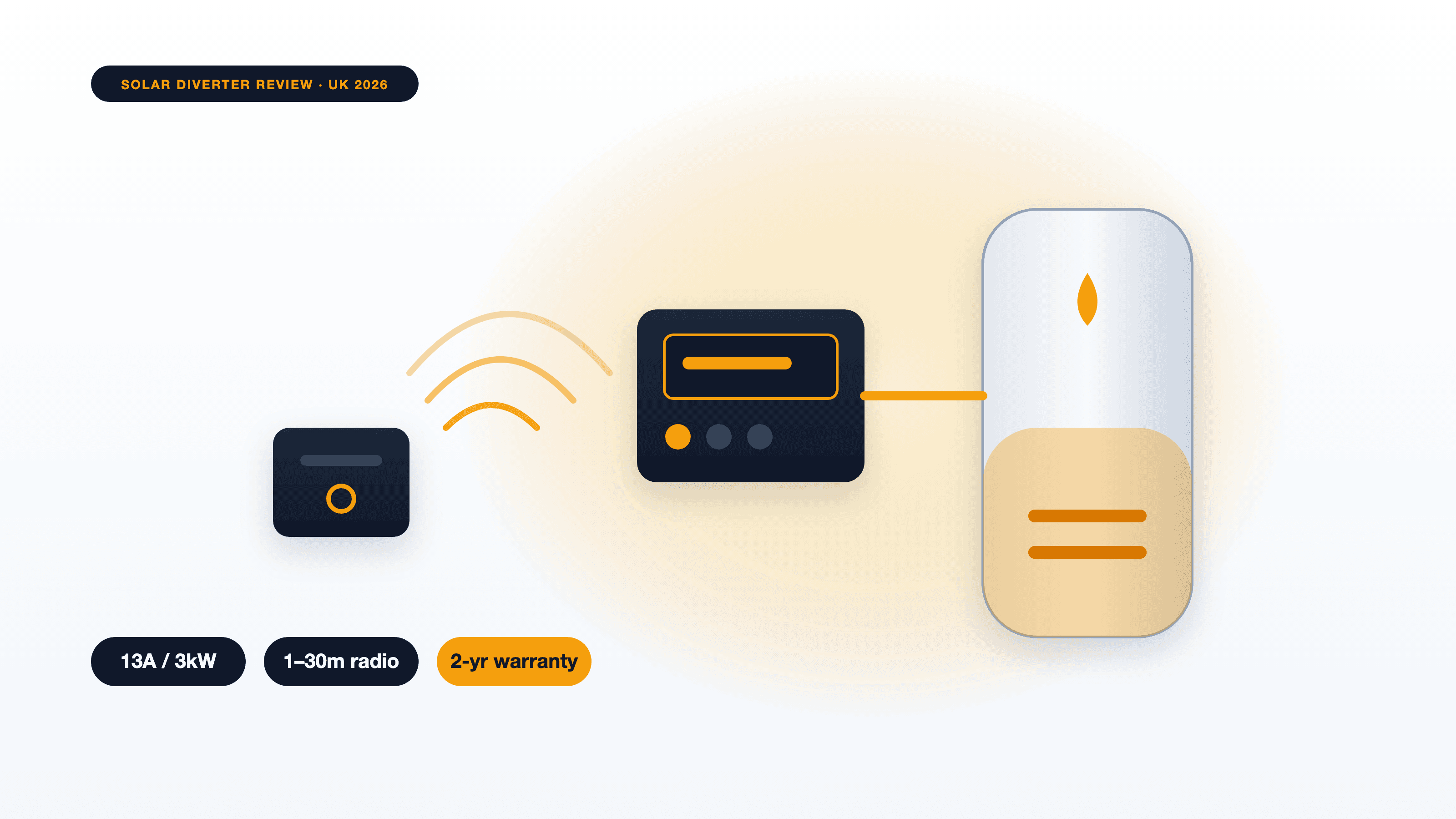
The Marlec Solar iBoost+ is a solar diverter: a small controller that sends surplus solar power to your hot water cylinder's immersion heater instead of exporting it to the grid. What sets it apart from rivals such as the myenergi eddi is how it measures that surplus: a battery-powered wireless sender clamps onto your main incoming cable at the meter and radios the reading to the controller, so no data cable has to run between the meter and the cylinder. This review draws on Marlec's own manual, specification page and product page, and covers what the iBoost+ does, what you need, what it costs and where it falls short.
How the Solar iBoost+ works
A measurement clamp sits around the household main incoming live cable at the utility meter (not the generation meter). It plugs into a sender unit that radios the export reading to the iBoost+ controller, which is mounted near the hot water tank. When exports pass a threshold the controller feeds power to the immersion heater, so you heat water with solar you would otherwise have sold back. Marlec says the cut-in is factory pre-set to operate when exports exceed 100W and can be adjusted in 50W steps up to 500W. When the tank thermostat is satisfied, diverting stops, and with two immersion elements it can move on to the second.
The financial logic is the same as for any diverter. Exported power earns a Smart Export Guarantee (SEG) rate that is set by your supplier, typically around 3–15p/kWh. Heating water with that power displaces electricity or gas you would otherwise pay for later. For how a diverter compares with a battery or EV charger as a destination for surplus, see our solar diverter vs battery vs EV charging guide.
Key specifications
- Maximum load: 13A resistive, up to a 3kW immersion heater (Marlec's manual).
- Supply: 220–240V AC, from a 16A MCB or 13A fused outlet.
- Controller size and rating: 225 x 158 x 92mm, IP20 (indoor use), operating range 0–40°C.
- Sender: 95 x 75 x 35mm excluding the clamp, IP40, two AA batteries, radio range 1–30m indoors depending on construction. Marlec's spec page says battery life is up to two years.
- Timer and boost: a 5-day/2-day programmable timer, plus a boost button that adds 15 minutes of grid-powered heating per press, up to two hours.
- Display: shows heating-by-solar status and energy saved today, yesterday, over 7 and 28 days, and in total (kWh).
- Warranty: 24 months from purchase, voided by improper installation.
There is no Wi-Fi or app on the controller itself. Marlec sells a separate iBoost+ Buddy, a small wireless display and remote control, for about £99 on its own site. It shows savings and net consumption or export and lets you trigger boost and switch the timer from elsewhere in the house.
What you need before it will work
A hot water cylinder with an immersion heater rated up to 3kW and a working thermostat. Marlec's manual says the thermostat is mandatory. A combi boiler has no tank, so there is nothing to heat.
No electronic controls between the iBoost+ and the immersion. Only direct connections to the immersion and a mechanical thermostat are suitable. If your immersion currently runs through a smart switch or electronic timer, it needs rewiring first.
The cylinder within radio range of the meter. Marlec says the cylinder-to-utility-meter distance should be under 30m, and the stated 1–30m range is indoors, so thick walls reduce it.
A qualified electrician. The manual says electrical installation must only be done by a suitably trained and qualified electrician and must satisfy the wiring regulations in force. Marlec says fitting typically takes under 40 minutes, but the clamp orientation matters: fitted the wrong way round, it will not detect export correctly, so the commissioning test is worth watching.
Legionella and weekly hot water
Marlec's manual reminds users that stored hot water should regularly reach 55–60°C to reduce the risk of bacteria growth, and recommends heating the tank to that range at least once a week using the boost facility or other heating controls. A diverter alone cannot guarantee that in dull weather, so keep the timer or boost in play over winter.
Solar iBoost+ price in the UK
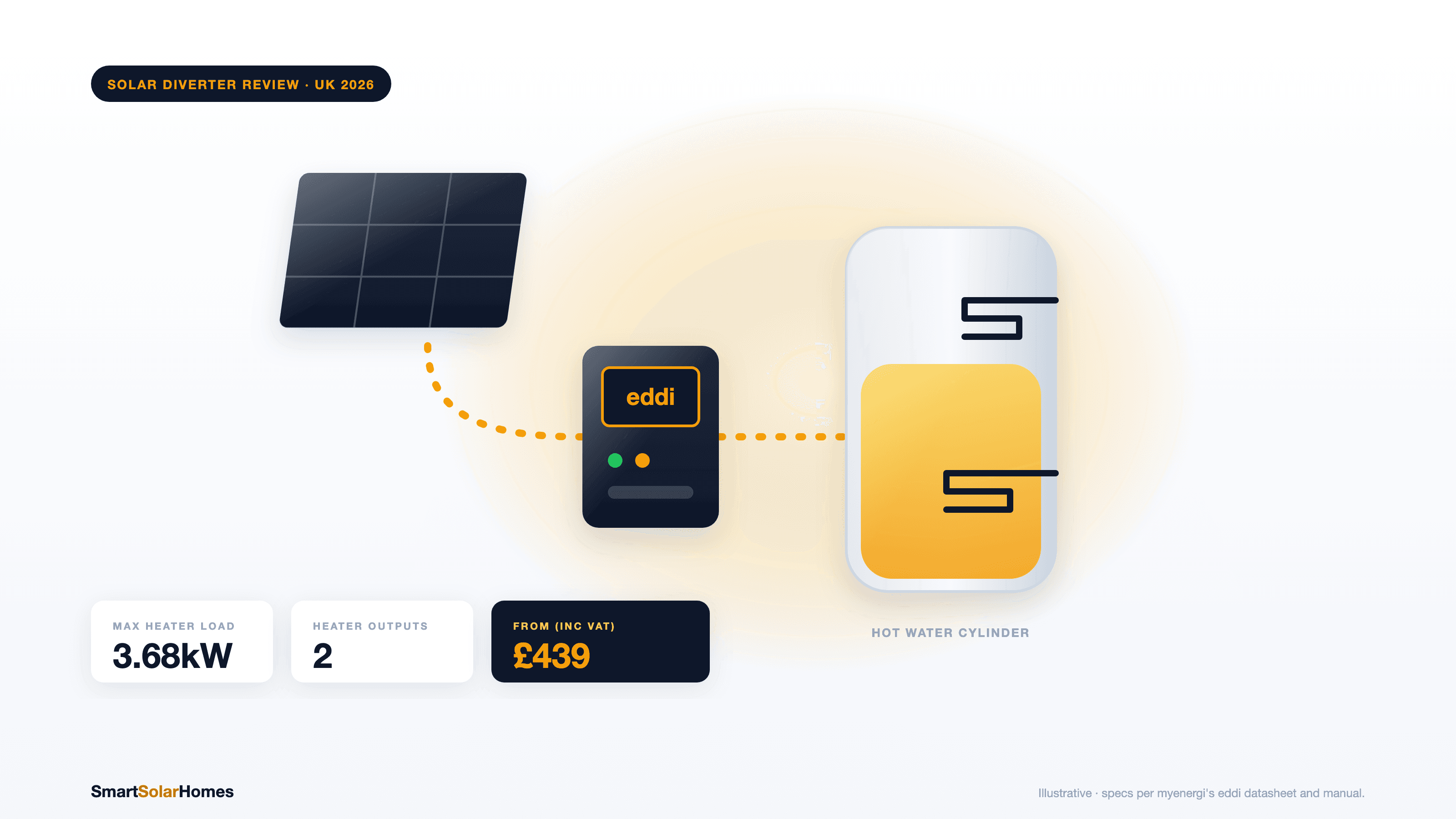
Marlec's own page does not list a price for the main unit, so retailer prices are the guide. In October 2026 we found it from about £295 inc. VAT at one specialist retailer, with others at around £305–£329 and one trade supplier above £450. Our product database carries an older ~£239 figure, so treat any price as a snapshot and add installation labour. Compare the total with the roughly £439 myenergi lists for the eddi.
Solar iBoost+ vs myenergi eddi
The two are closer than the spec sheets suggest, but they differ in ways that matter:
- Metering: the iBoost+ is wireless by default; the eddi uses a wired clamp unless you add the separate harvi sensor.
- Power: the iBoost+ tops out at a 3kW immersion; the eddi handles up to 3.68kW.
- Smarts: the eddi has Wi-Fi and an app; the iBoost+ has neither, though the Buddy adds a remote display.
- Warranty: two years against the eddi's three.
Our best solar diverter guide compares them side by side, and the myenergi eddi review covers the alternative in detail.
With a battery
If you have a home battery, it will usually soak up surplus first, leaving less for a diverter. Marlec advises keeping at least a 50W gap between the iBoost+ and battery cut-in thresholds so the two do not fight over the same watts. Our self-consumption guide explains how to prioritise between them.
Verdict
Buy the iBoost+ if your cylinder is far from the meter, your immersion is 3kW or under with a plain thermostat, and you want a simple fit-and-forget unit without an app. Look elsewhere if you want Wi-Fi control, a higher load, a longer warranty or integration with an EV charger, in which case the eddi is the stronger fit. It will not suit combi-boiler homes at all.
FAQs
How much does a Solar iBoost+ cost UK?
Does the Solar iBoost+ have an app?
What is the maximum load of the Solar iBoost+?
How far can the iBoost+ sender be from the controller?
What warranty does the Solar iBoost+ have?
Will a Solar iBoost+ work with a combi boiler?
Sources — verified 29 October 2026
- Marlec, “Solar iBoost+ product page (features, cut-in threshold, boost, warranty, Buddy)” — www.marlec.co.uk
- Marlec, “Solar iBoost+ specifications (load, IP rating, sender range, dimensions)” — www.marlec.co.uk
- Marlec, “Solar iBoost installation and operating instructions (thermostat, wiring, clamp, warranty, 55-60°C guidance)” — www.marlec.co.uk
- myenergi, “eddi power diverter product page” — www.myenergi.com
- Energy Saving Trust, “Smart Export Guarantee (SEG) rates” — energysavingtrust.org.uk

About the author
Sepehr
Solar specialist & co-founder, Smart Solar Homes
Solar specialist and co-founder of Smart Solar Homes, which works with MCS-certified UK installer partners. I write all the guides and reviews here; the aim is straight-talking education the industry rarely provides.
Citing this page? Please use a dofollow link back to the original article — it helps us keep the data on this page accurate and up to date.
Browse Solar Diverters on Smart Solar Homes


Want to compare these side by side? Use the compare tool →
Or browse all Solar Diverters on Smart Solar Homes.
Related reading
More on solar diverters from the editorial team.


Find installers near you
MCS-certified solar installers covering these areas.