myenergi Eddi Review UK: Solar Diverter Price & Specs
Written and reviewed by Sepehr. See our editorial policy.
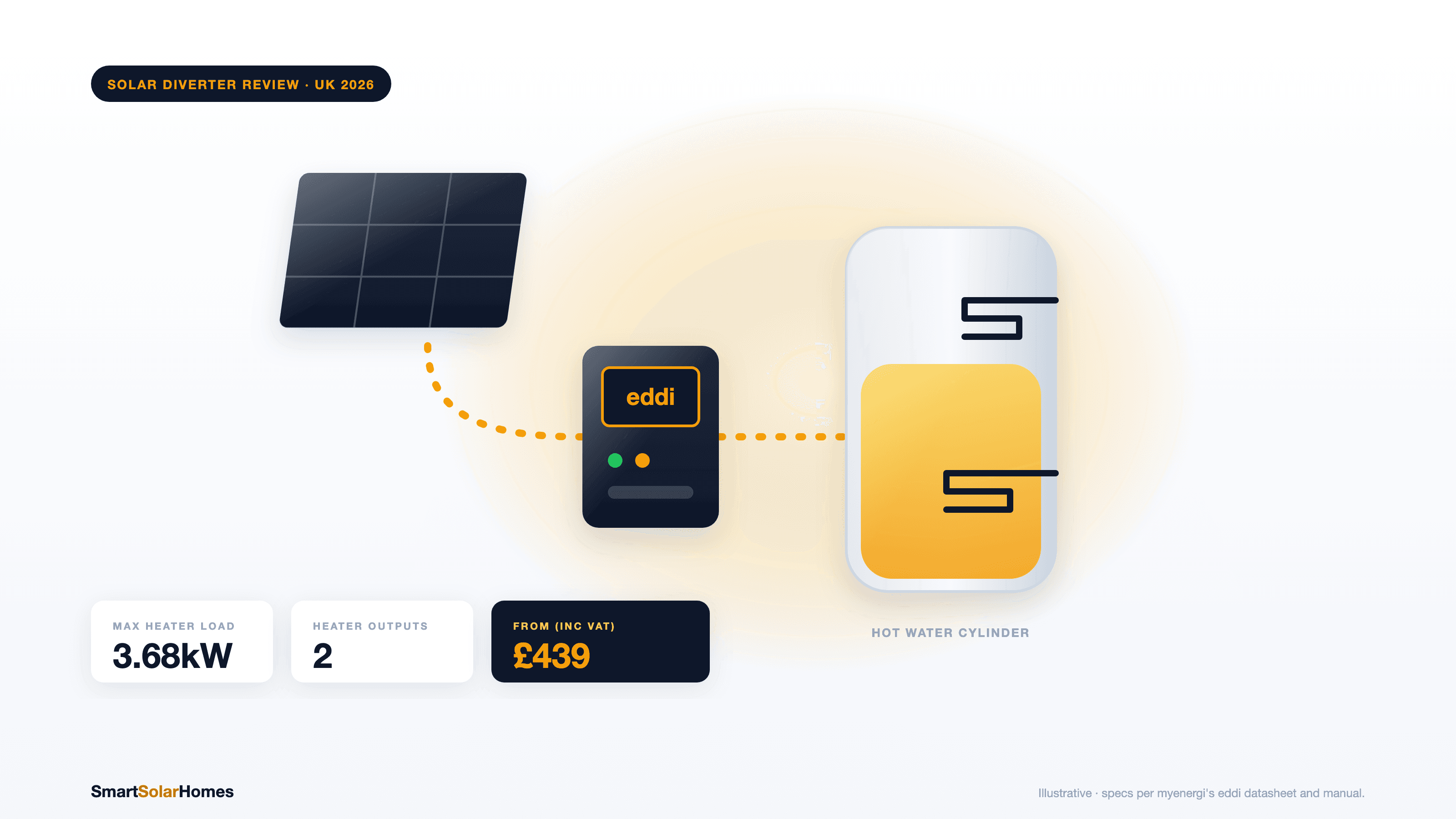
The myenergi eddi is a solar diverter: a wall-mounted box that sends surplus solar power to your immersion heater instead of letting it export to the grid. It is the best-known product of its kind in the UK, made by myenergi of Grimsby alongside the Zappi EV charger and Libbi battery. This review is built from myenergi's own datasheet, installation manual and product page, and covers what the eddi actually does, what it costs, what you need before it will work, and where it falls short.
What the eddi does
A current-sensing clamp (CT) fitted around your incoming supply cable tells the eddi how much solar power you are exporting. The eddi then raises or lowers the voltage to a resistive heater, usually the immersion element in your hot water cylinder, so that it soaks up exactly the surplus. myenergi says it uses its proprietary "VariSine" pure sine wave control rather than crude on-off switching, and that this keeps it compatible with all inverters and import/export meters. When the cylinder thermostat opens ("Max Temp Reached" on the screen), the eddi stops diverting; with a second heater connected, it switches across to that one instead.
The point is financial. Exported power earns a Smart Export Guarantee (SEG) rate that is supplier-set, typically around 3–15p/kWh according to the Energy Saving Trust, while grid electricity under the Ofgem default-tariff cap was 26.11p/kWh for July–September 2026. Hot water you heat yourself with surplus solar is hot water you do not buy later. For the wider comparison against a battery or EV charger, see our solar diverter vs battery vs EV charging guide.
Key specifications
- Maximum heater load: 3.68kW / 16A per heater, minimum 100W (the datasheet lists 100W; the installation manual says 150W for installed loads).
- Outputs: two heater outputs, run one at a time with selectable priority.
- Supply: 230V single phase, from a dedicated 16A breaker, or a fused spur if the heater is under 3kW. A three-phase version, the eddi+, is sold separately.
- Connectivity: built-in Wi-Fi and an Ethernet port, with control through the myenergi app.
- Standby draw: 3W typical.
- Size and rating: 220 x 205 x 87mm, 4.3kg, IP20, so indoor use only, with a fan-less case.
- Warranty: 3 years as standard.
- Price: myenergi lists it from £439 inc. VAT where applicable (1-phase and 3-phase).
That £439 headline is higher than the roughly £289 often quoted for the eddi by retailers in older roundups, so treat any price as a snapshot and get an installer quote including labour.
What you need before an eddi works for you
A hot water cylinder with an immersion heater. Combi boilers have no tank, so there is nothing for the eddi to heat. The eddi can also drive any purely resistive load up to 3.68kW — myenergi lists storage heaters, convection heaters and underfloor heating mats — but a cylinder is by far the most common target.
Mechanical thermostats only. The manual is explicit: no electronic controls and no timers, including mechanical timers, may be wired to the heater terminals. A cylinder whose immersion is wired through a timer or smart switch needs rewiring first.
A competent installer. The manual requires anyone commissioning the unit to be suitably qualified and competent with electrical installations. myenergi says installation can take under an hour and that DIY is possible, but recommends consulting an electrician; we would go further and use one, because it involves a dedicated circuit and live-side work.
Somewhere to clip the sensor. A CT clamp with a 5m cable is supplied. If your cylinder is a long way from the meter, the cable can be extended with Ethernet cable, or you can use myenergi's separate wireless harvi sensor. Three-phase installs and a live generation readout on the screen need a second clamp.
Day-to-day use
The eddi's backlit LCD shows the current state at a glance: waiting for surplus, heating (with the diverted kW and the day's accumulated kWh), max temperature reached, or boosting. Three controls matter in practice:
- Manual boost runs a heater at full power for a set time (it starts at one hour and can be adjusted), regardless of surplus. Expect to import from the grid while it runs.
- Boost timers let you programme full-power heating at set times, which is how you guarantee hot water on dull days. You can also tie boosting to an economy-tariff signal via the optional Relay & Sensor Board.
- Grid and device limits cap how much the eddi can draw, which helps if your supply or fuse is tight.
For homes with a two-element cylinder, wiring the top element to Heater 1 and the bottom to Heater 2 lets the eddi fill the top first and then switch to the bottom, which is the arrangement myenergi's manual recommends for electric-only households.
Batteries, heat pumps and other myenergi kit
myenergi says the eddi works alongside battery storage, and its settings include a battery mode for managing priority between the two. With a battery, the battery typically absorbs surplus too, so a diverter has less left to work with than on a solar-only system; our self-consumption guide covers how the pieces fit.
The datasheet also flags heat pump compatibility when the optional Relay & Sensor Board is fitted, which allows interfacing with a heat pump's immersion for Legionella control. If you are weighing a heat pump, see our best air source heat pumps guide; the eddi is a niche add-on there rather than a core part of the system. If you are also weighing a solar-aware EV charger, see our myenergi Zappi review.
The limits
It only heats resistively. Immersion heating is 100% efficient as electricity-to-heat but a heat pump produces several units of heat per unit of power, so for a heat-pump home, diverting solar into an immersion is a use of surplus, not the cheapest way to make hot water.
Value depends on what your hot water currently runs on. If it is gas-heated, the eddi displaces gas, not 26p electricity, so savings are smaller than in an electric-immersion home. We have not found an independent source for a standard UK saving figure, so be wary of any installer quoting one without your usage data.
Summer-heavy. Surplus is plentiful from spring to early autumn and scarce in winter, which is when the cylinder is working hardest.
IP20 and indoor only. It needs a dry spot near your consumer unit, such as an airing cupboard or utility room.
eddi vs the alternatives
The main rival is the Marlec Solar iBoost+. Our best solar diverter UK comparison covers the iBoost+ and the Immersun in detail. In short, the eddi's selling points are its second output, app control and battery awareness. If you only need one immersion heated and no app, a simpler unit can be enough. If you have a battery and plenty of export left over, or an EV and no home charger yet, a battery or a solar-aware charger may repay you better first.
Our verdict
The eddi is a mature, well-documented piece of kit that does one job properly: it turns exported solar into hot water with smooth power control, two outputs, an app and a 3-year warranty. It is best for an electric-immersion home with a decent solar array, no battery or a modest one, and a cylinder you are happy to wire to a dedicated circuit. It is a weaker buy for gas-heated hot water, a combi boiler, a winter-heavy heat load or a home that already exports very little. Check your own export first: your smart meter or inverter app will show how many kWh you send to the grid each summer, and that number tells you whether £439 plus installation pays back.
FAQs
How much does a myenergi eddi cost?
Does the myenergi eddi work with a combi boiler?
What is the maximum load for a myenergi eddi?
Does the myenergi eddi work with a home battery?
Can I install a myenergi eddi myself?
Does the eddi need a CT clamp?
Sources — verified 23 October 2026
- myenergi, “eddi power diverter product page (price, warranty, Wi-Fi, load)” — www.myenergi.com
- myenergi, “eddi 2.1 datasheet (Revision 2.0, June 2022)” — www.myenergi.com
- myenergi, “eddi operation and installation manual” — support.myenergi.com
- Energy Saving Trust, “Solar panels: costs, savings and benefits explained” — energysavingtrust.org.uk
- Ofgem, “Changes to energy price cap between 1 July and 30 September 2026” — www.ofgem.gov.uk

About the author
Sepehr
Solar specialist & co-founder, Smart Solar Homes
Solar specialist and co-founder of Smart Solar Homes, which works with MCS-certified UK installer partners. I write all the guides and reviews here; the aim is straight-talking education the industry rarely provides.
Citing this page? Please use a dofollow link back to the original article — it helps us keep the data on this page accurate and up to date.
Browse Solar Diverters on Smart Solar Homes


Want to compare these side by side? Use the compare tool →
Or browse all Solar Diverters on Smart Solar Homes.
Related reading
More on solar diverters from the editorial team.


Find installers near you
MCS-certified solar installers covering these areas.