The History of Solar Energy: From Bell Labs to Your Roof

Written and reviewed by Sepehr. See our editorial policy.
The solar panel on a modern UK roof is the end point of a story that runs through a French physics lab, a New Jersey research campus, and an American satellite launchpad before it ever reaches a British street. The history of solar energy spans nearly two centuries — but the technology only became something a homeowner could actually buy in the last few decades, and only became commonplace in the UK in the last fifteen years. Here's how a laboratory curiosity became one of the fastest-growing home improvements in the country.
1839: A 19-year-old finds the effect in his father's lab
The starting point is Edmond Becquerel, a French physicist who was just 19 when he made the discovery in 1839. Experimenting in his father's laboratory, he placed silver chloride in an acidic solution, connected it to platinum electrodes, and found that shining light on the setup generated a small voltage and current. Becquerel called it the photovoltaic effect — light converting directly into electricity — and it would sit as a laboratory footnote for more than 40 years before anyone built a device around it.
1883: The first working solar cell
That changed in 1883, when American inventor Charles Fritts built the first genuine solar cell in a New York workshop. He coated a wafer of selenium with an extremely thin layer of gold — thin enough to let light through while still conducting electricity — and produced what he described as a current that was "continuous, constant, and of considerable force." It converted only around 1–2% of sunlight into electricity, a fraction of what today's panels manage, but it was a working proof of concept. Fritts even installed an array of his cells on a New York City rooftop, arguably the first rooftop solar installation anywhere. He sent a sample to the German engineer Werner von Siemens, who recognised its significance and helped bring the idea to wider scientific attention in Europe.
1954: Bell Labs and the silicon breakthrough
Selenium cells were too inefficient and expensive to be more than a curiosity, and progress stalled for decades. The real turning point came at Bell Labs in New Jersey in the early 1950s. Engineer Daryl Chapin was searching for a reliable power source for telephone equipment in humid, remote locations where standard batteries corroded too quickly. He was working with selenium cells until physicist Gerald Pearson — who was experimenting with silicon alongside chemist Calvin Fuller — suggested he stop wasting time on selenium and switch to silicon instead.
The three solved a string of technical problems, including how to keep the cell's electrical junction stable near the surface using arsenic and boron impurities, and on 25 April 1954 Bell Labs announced the result: a silicon "solar battery" that converted around 6% of sunlight into usable electricity — roughly four times better than the best selenium cells. The announcement cell powered a toy Ferris wheel and a small radio transmitter for the press, and it is generally recognised as the first practical solar cell — the direct ancestor of the silicon panels fitted on UK roofs today. See how solar panels work for how that same silicon photovoltaic effect functions in a modern panel.
1958: Solar power goes to space
Solar cells were still far too expensive for ordinary use in the 1950s, but they solved a problem nobody else could: powering a spacecraft indefinitely without carrying fuel. On 17 March 1958, the US satellite Vanguard 1 launched carrying six small silicon solar panels alongside a battery-powered backup transmitter. The battery packed in died within weeks, but the solar-powered transmitter kept working until 1964 — a decade after Bell Labs' announcement. Vanguard 1 is still in orbit today, the oldest human-made object still circling the Earth, and its success made solar power the default choice for spacecraft power for the rest of the space age. That government and space-programme demand is what kept solar cell research funded through the 1960s, even while the technology remained far too costly for a house.
The cost curve: from thousands of dollars a watt to a few cents
Cost, not capability, was the barrier that kept solar off ordinary roofs for another 20 years. Historical US estimates put the price of a watt of solar capacity in the mid-1950s at close to $2,000 in today's money — affordable only for space programmes and specialist industrial uses, not homes. The 1970s oil crisis triggered the first serious push to bring that cost down for terrestrial use, and by the end of that decade module prices had fallen to roughly $20 per watt as manufacturers began producing cells specifically for non-space applications rather than adapting satellite technology. Prices kept falling through the 1980s and 1990s as manufacturing scaled up, reaching around $10/W by the 2000s.
That decline has followed a remarkably consistent pattern known as the learning curve, or Swanson's Law: module prices have historically fallen by roughly 20% for every doubling in cumulative global solar capacity installed, driven by manufacturing scale, technological refinement, and — critically — government demand-side policies, which research estimates account for around 60% of the total cost decline. The result is that a solar module now costs a small fraction of a percent of its 1950s price per watt, which is the single biggest reason solar went from space-programme exclusivity to a mainstream home upgrade. See solar panel cost and savings for what installing a system actually costs a UK household today.
The UK's solar story: from a niche subsidy to two million roofs
Solar panels existed on a handful of pioneering UK homes from the 1990s onward, but the technology only went mainstream after the government introduced the Feed-in Tariff (FIT) on 1 April 2010. FIT paid homeowners a fixed rate for every unit of solar electricity they generated, plus a further payment for anything exported to the grid, guaranteed for up to 20 years. It transformed the economics of a home system almost overnight and triggered the UK's first real residential solar boom. See solar grants and funding schemes for how UK solar incentives have evolved since.
The scheme closed to new applicants on 1 April 2019 as costs kept falling and government support was scaled back, but existing FIT customers kept receiving payments for the remainder of their agreed terms. It was replaced from 1 January 2020 by the Smart Export Guarantee (SEG), which pays for electricity exported to the grid but, unlike FIT, leaves it to homeowners to shop around suppliers for the best export rate rather than offering one fixed government-set tariff.
From Bell Labs to your roof
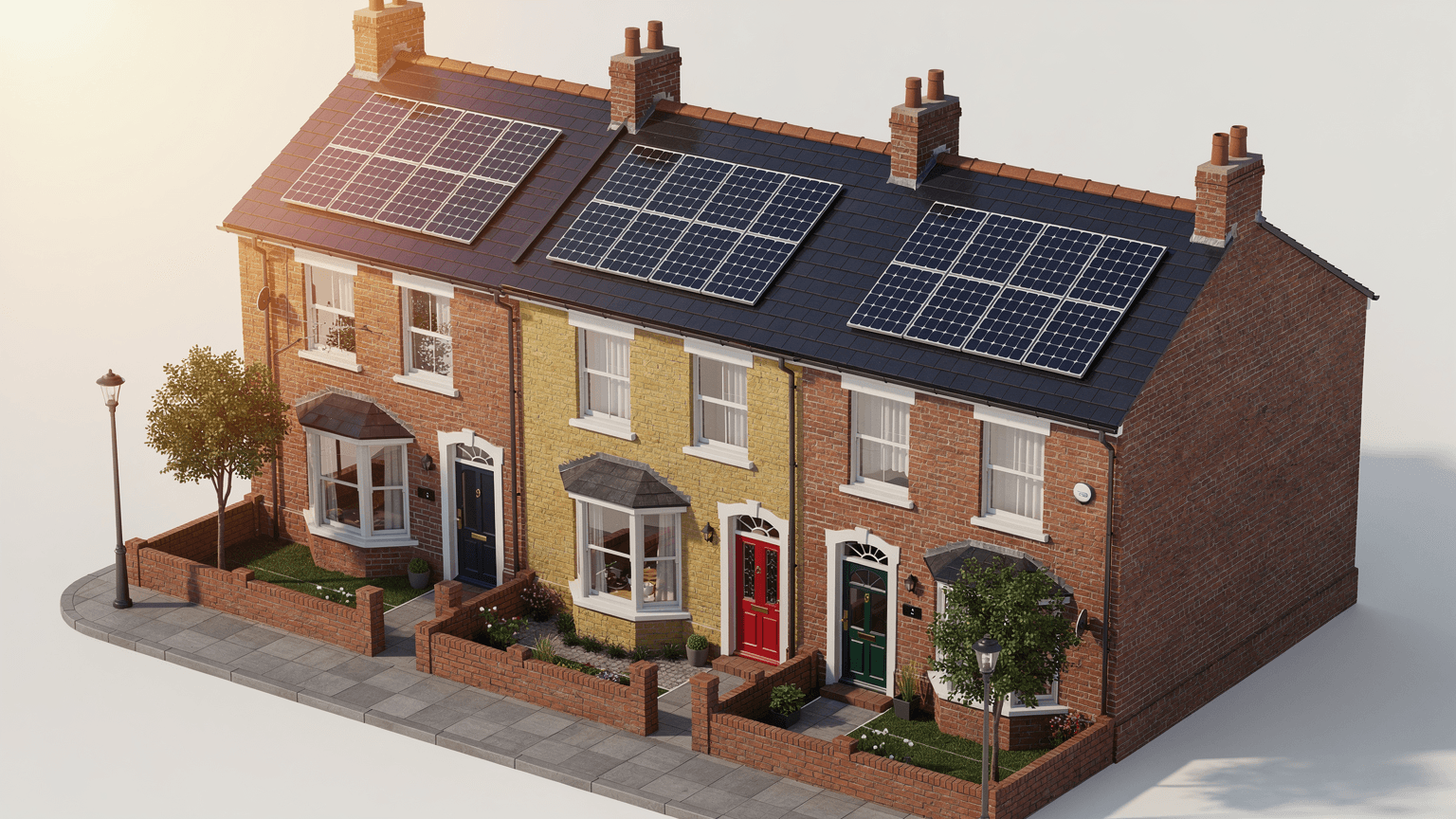
The scale of what's happened since is hard to overstate. According to provisional government figures, total UK solar capacity reached around 22.1 GW by the end of March 2026, spread across more than two million individual installations — a technology that spent its first 115 years as a laboratory and space-programme novelty is now installed on a meaningful share of British homes, most of it certified through the MCS certification scheme that underpins SEG eligibility and installer standards. A typical UK home system today generates several times more electricity per panel, at a fraction of the historic real-terms cost, than anything Bell Labs' engineers could have imagined powering a house with in 1954 — see solar panel output in the UK for what a modern system actually produces.
From a 19-year-old's curiosity in a French laboratory to a satellite that still circles the Earth, to a subsidy scheme launched to hit UK climate targets — the line from Edmond Becquerel to a solar panel on a semi-detached roof in Cornwall is a genuinely direct one. It just took 187 years to get there.
FAQs
Who invented solar panels?
When were solar panels invented?
When did solar panels become popular in the UK?
Why were early solar cells too expensive for homes?
Sources — verified 17 August 2026
- American Physical Society, “This Month in Physics History: Bell Labs Demonstrates the First Practical Silicon Solar Cell” — www.aps.org
- Smithsonian Magazine, “Document Deep Dive: The Patent for the First Practical Solar Cell” — www.smithsonianmag.com
- Smithsonian Magazine, “A Brief History of Solar Panels” — www.smithsonianmag.com
- NASA, “Vanguard 1 — NSSDCA Spacecraft Details” — nssdc.gsfc.nasa.gov
- Ofgem, “Feed-in Tariffs (FIT)” — www.ofgem.gov.uk
- Ofgem, “Feed-in Tariffs: Essential Guide to Closure of the Scheme” — www.ofgem.gov.uk
- GOV.UK, “Solar photovoltaics deployment statistics” — www.gov.uk
- pv magazine, “There are now more than 2 million UK solar installations” — www.pv-magazine.com
- Our World in Data, “Why did renewables become so cheap so fast?” — ourworldindata.org

About the author
Sepehr
Solar specialist & co-founder, Smart Solar Homes
Solar specialist and co-founder of Smart Solar Homes, which works with MCS-certified UK installer partners. I write all the guides and reviews here; the aim is straight-talking education the industry rarely provides.
Citing this page? Please use a dofollow link back to the original article — it helps us keep the data on this page accurate and up to date.
Browse Solar Panels on Smart Solar Homes


Want to compare these side by side? Use the compare tool →
Or browse all Solar Panels on Smart Solar Homes.
Related reading
More on solar panels from the editorial team.
Find installers near you
MCS-certified solar installers covering these areas.