AR8: What the Next Renewables Auction Means for Your Bill
Written and reviewed by Sepehr. See our editorial policy.
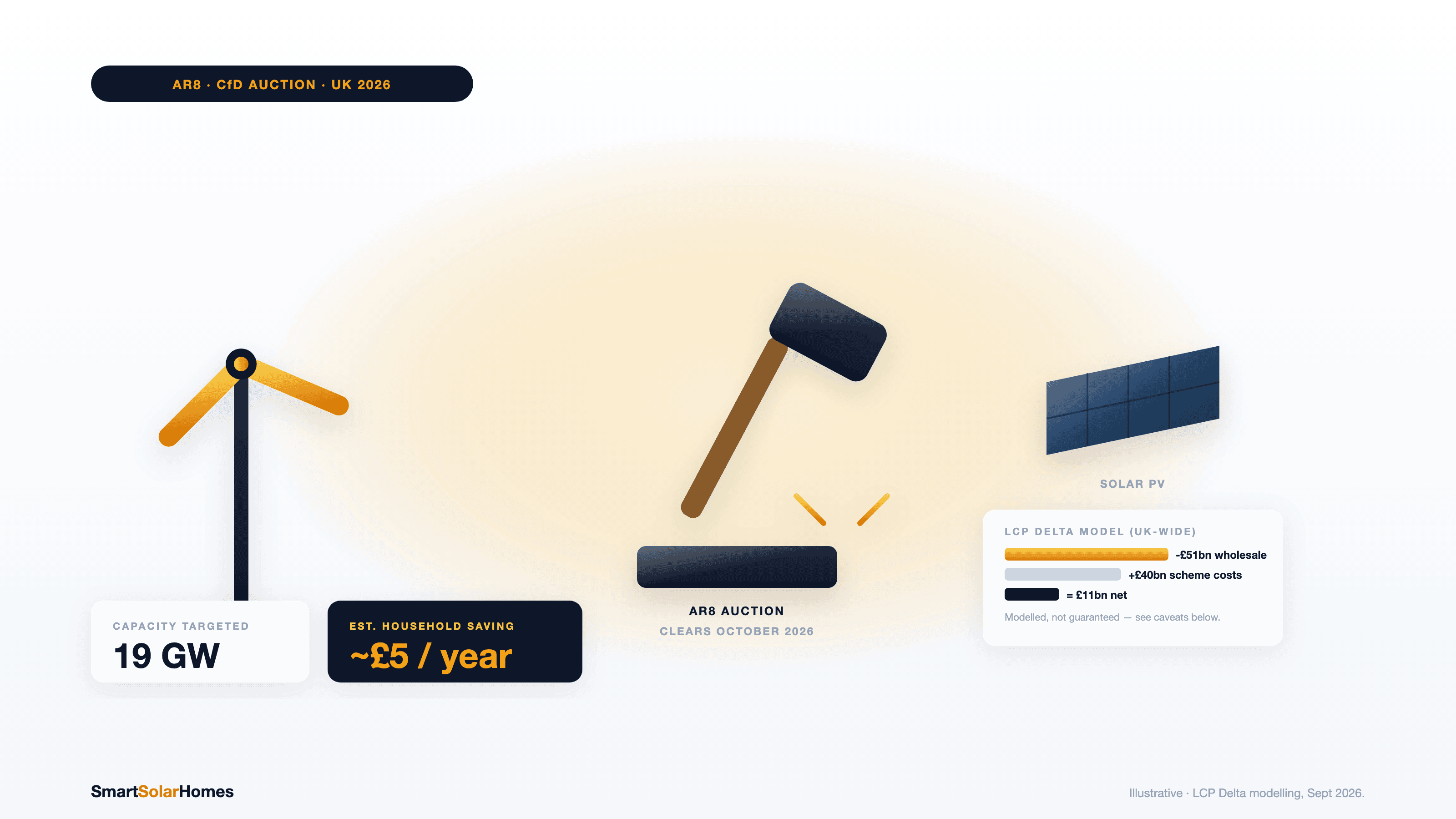
The government's eighth Contracts for Difference auction, AR8, opens this autumn and could reshape a meaningful slice of the UK's electricity mix — and, according to a new industry analysis, knock a small but real amount off everyone's bill. Energy consultancy LCP Delta, in a report titled AR8: A Different Kind of Auction, forecasts that AR8 could procure up to 19GW of new renewable capacity and deliver roughly £11 billion in net savings for UK energy customers. That headline number needs some unpacking, and the report itself is careful to say the household impact is uncertain — but the mechanics behind it are worth understanding if you already generate your own solar power, or are weighing up whether to.
What is AR8, in plain terms?
The Contracts for Difference (CfD) scheme is the UK government's main tool for funding new low-carbon electricity generation. Under a CfD, a developer — of a solar farm, offshore wind array, or other renewable project — agrees a fixed "strike price" for the electricity it generates over 15 years. If the market price falls below that strike price, the government tops the developer up; if the market price rises above it, the developer pays the difference back. The scheme is administered by the Low Carbon Contracts Company on behalf of the Department for Energy Security and Net Zero, and contracts are awarded through competitive, pay-as-clear auctions where the cheapest bids win.
AR8 is simply the eighth round of that auction. Each round has procured more capacity at falling strike prices as renewable technology has matured, and AR8 is expected to continue that trend when it runs from October 2026.
Where the £11bn savings figure comes from
LCP Delta's report, produced with EnergyPulse and SolarPulse, models AR8 procuring up to 19GW of new renewable capacity. Its central estimate is that this would reduce wholesale electricity costs by £51 billion. Set against that are the costs of the scheme itself: roughly £38 billion in CfD support payments to developers, plus around £2 billion in additional balancing and capacity-adequacy costs to keep the grid stable with more variable generation on it. Net that out and LCP Delta arrives at a £11 billion saving for UK energy customers overall — which it translates to roughly £5 off a typical household's annual electricity bill.
The report also gives indicative clearing-price forecasts by technology: solar PV at around £68 per megawatt-hour, onshore wind at £86/MWh, fixed-bottom offshore wind at £92/MWh, and floating offshore wind considerably higher at around £206/MWh — reflecting how much further that technology still has to fall in cost. AR8's maximum strike price for solar is reported at £75/MWh.
The caveat matters as much as the headline. LCP Delta's own report acknowledges that "consumer benefits are potentially substantial but highly sensitive to assumptions" — a reminder that £11 billion is a modelled scenario, not a guarantee, and that a £5-per-household figure is an average smoothed across the whole country, not a promise on any individual bill. Wholesale prices, auction clearing rates and how much of any saving suppliers pass through are all variables outside the report's control.
Why this still matters if you already have solar
It is easy to read AR8 as a story about utility-scale wind and solar farms rather than rooftop panels. But the logic connects directly to two things solar owners already track closely: the wholesale price that ultimately feeds into Ofgem's energy price cap, and the broader push to get Britain off gas-set electricity pricing described in our guide to why UK energy bills are so high. More CfD-backed renewable capacity on the grid means less reliance on gas-fired power stations to set the marginal price at times of high demand — the mechanism that currently keeps electricity prices tied to volatile gas markets even when wind and solar are cheaper to run. Every gigawatt of new low-carbon capacity procured through AR8 is, in principle, a gigawatt less exposed to the next gas price spike.
For homeowners with their own generation, that is a complementary trend rather than a competing one: your own panels shield you from the cap's ups and downs on the electricity you self-consume, while a successful AR8 auction works on the wholesale price everyone — including your supplier's residual purchases on your behalf — ultimately pays.
What happens next
AR8's application window and auction process runs through autumn 2026, with results typically announced some months after an allocation round closes — AR7's results, for comparison, took several months to confirm after its own application window shut. There is no action for households to take now; this is a wholesale-market and government-policy story, not a scheme you apply to directly. The practical effect, if any, will show up gradually in future Ofgem price cap resets rather than as a one-off bill credit.
We'll update this page once AR8's results are confirmed and it becomes clearer how much of the modelled saving is actually delivered.
FAQs
What is AR8?
How much could AR8 save on household energy bills?
Does AR8 affect people who already have solar panels?
Do I need to do anything because of AR8?
Sources — verified 27 September 2026
- Solar Power Portal, “UK AR8 could procure 19GW of renewables, deliver £11bn in savings, says LCP Delta” — www.solarpowerportal.co.uk
- GOV.UK, “Contracts for Difference (CfD) Allocation Round 8: allocation framework” — www.gov.uk
- GOV.UK, “Contracts for Difference” — www.gov.uk
- Ofgem, “Supplier obligations: environmental and social schemes” — www.ofgem.gov.uk

About the author
Sepehr
Solar specialist & co-founder, Smart Solar Homes
Solar specialist and co-founder of Smart Solar Homes, which works with MCS-certified UK installer partners. I write all the guides and reviews here; the aim is straight-talking education the industry rarely provides.
Citing this page? Please use a dofollow link back to the original article — it helps us keep the data on this page accurate and up to date.
Browse Solar Panels on Smart Solar Homes


Want to compare these side by side? Use the compare tool →
Or browse all Solar Panels on Smart Solar Homes.
Related reading
More on solar panels from the editorial team.

Find installers near you
MCS-certified solar installers covering these areas.