FlatSave: E.ON Next and Allume Launch Shared Solar for UK Flats
Written and reviewed by Sepehr. See our editorial policy.
E.ON Next and Allume Energy have launched FlatSave, a new commercial scheme that pairs shared solar generation with a communal battery and grid flexibility payments for residents of flats and social housing. It's the first named, supplier-backed product to come out of E.ON's 2025 investment in Allume, and it directly answers a question our own SolShare 2 coverage left open back in August: whether E.ON would actually roll Allume's shared-solar technology out to UK customers itself, rather than simply backing it as an investor. FlatSave is that rollout, announced in early September 2026.
What FlatSave actually is
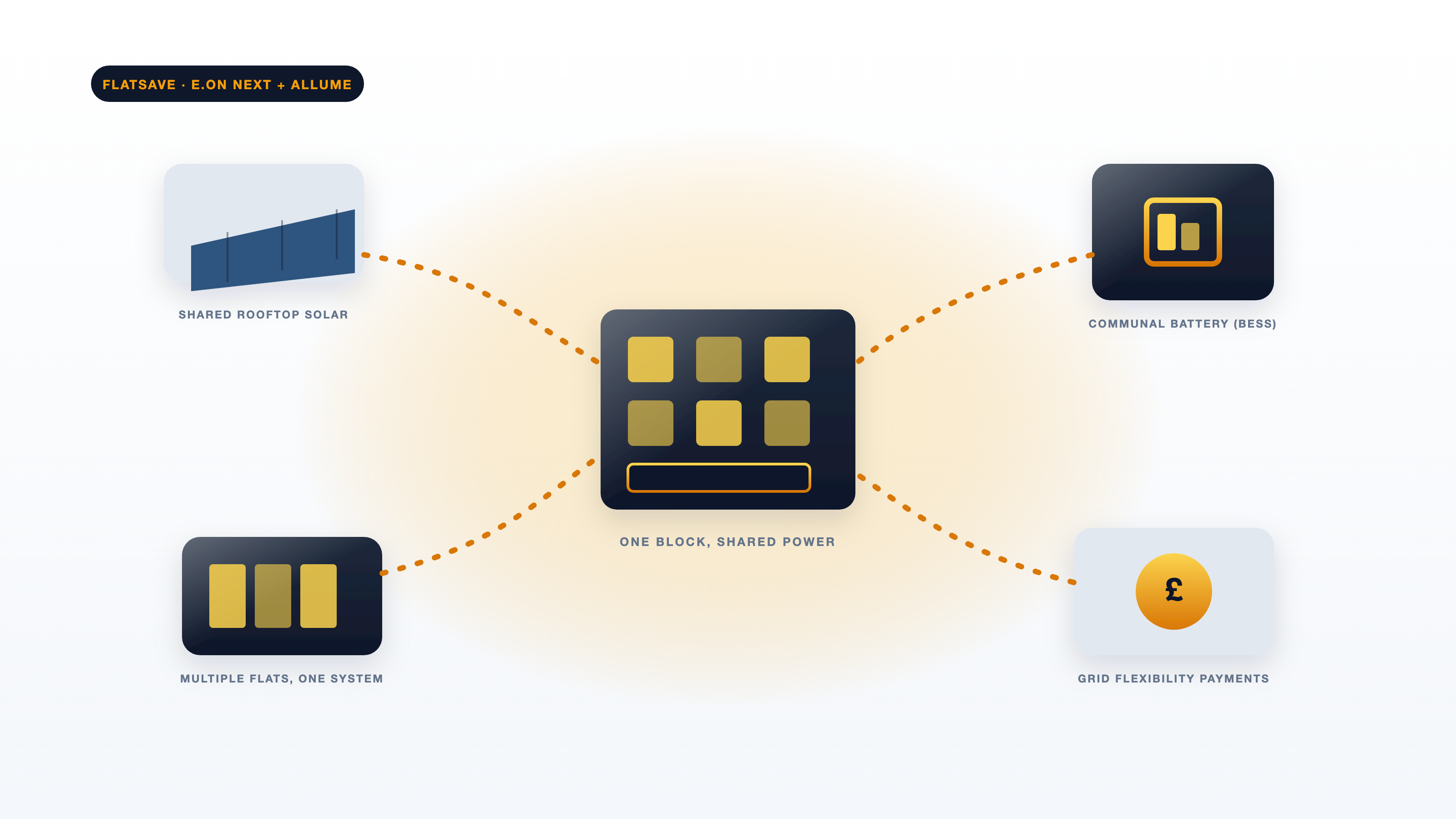
FlatSave layers three things on top of one building's solar array: shared allocation of the generation across every flat in the block (using Allume's existing SolShare technology, covered in detail in our SolShare 2 guide), a communal battery energy storage system (BESS) that stores midday surplus for evening use, and a grid flexibility layer that lets the battery also charge cheaply from the grid overnight and discharge back during peak demand periods, earning payments for doing so. Because the system sits behind the building's own meter, it's supplier-agnostic — an individual resident doesn't need to switch their own electricity contract to E.ON Next to receive free or discounted solar power through it, according to E.ON Next's own launch materials.
Where it's live, and what it's built from
The first confirmed FlatSave installation is at Harper Court, a Peabody Housing property in Stevenage, Hertfordshire, serving six residents. The deployed system combines a 15kW solar array with an 18kWh communal battery, per E.ON Next's launch announcement. E.ON Next says further housing-association properties are planned for later in 2026, though none beyond Harper Court had been named at the time of writing.
The savings and flexibility payments on offer
E.ON Next's own figures put the potential bill reduction at 30–60% off a typical flat's electricity costs, driven by residents using free or cheap solar and battery-stored power instead of grid electricity at full price. On top of that, residents can earn flexibility payments of up to £160 a year if they're an E.ON Next customer, or up to £80 a year if they're with a different supplier — the lower figure for non-E.ON Next customers reflects the fact that FlatSave's flexibility-trading revenue is optimised through E.ON Next's own systems. These are E.ON Next's own headline figures rather than an independent audit, and actual savings will depend on a flat's usage pattern and how much of the building's solar and battery capacity it's allocated, in the same way SolShare 2's own marketing claims needed caveating in our earlier coverage.
Why this matters for flats specifically
E.ON Next cites survey data showing more than 80% of UK residents want access to solar and battery storage, but around 22% say their home type makes it unsuitable — the gap FlatSave and SolShare-style shared systems are built to close, since flats rarely have private roof access or space for an individual system. For the wider funding picture — including how ECO4 and the Warm Homes Plan can support solar for social housing tenants — see our guide to free solar panels for council tenants. FlatSave is a variation on the same building-scale approach: it still needs a housing association, council or freeholder to commission it, exactly as our SolShare 2 coverage found was true of every confirmed UK deployment of the underlying shared-solar technology.
FlatSave vs plug-in solar and other flat routes
FlatSave sits alongside, rather than replaces, the other routes into solar for people who don't own a roof. If you're an individual leaseholder or renter with no say over a building's capital spending, plug-in and balcony solar, legal in the UK from 27 August 2026 for kits up to 800W, remains the option you can act on directly with your freeholder's consent. FlatSave and SolShare need the opposite: a landlord or housing association willing to invest in whole-building infrastructure, but at a scale that can meaningfully offset most of a flat's demand rather than provide a small top-up. For the fuller comparison of leaseholder consent, freeholder routes and communal solar generally, see our guide to solar panels for flats and leasehold homes, and for how the flexibility-payment side works more broadly, see our guide to virtual power plants and earning from grid flexibility.
What to do if you live in a flat or manage a block
FlatSave isn't something an individual flat owner can buy directly — as with SolShare, the practical route in is through a housing association, council landlord, freeholder or managing agent choosing to commission the system for the whole building. If you're a social housing tenant, it's worth asking your landlord whether they've looked at E.ON Next's FlatSave scheme or similar shared-solar retrofit funding. If you manage a private block, the same conversation applies to your freeholder or managing agent, alongside the existing ECO4 and Warm Homes Plan routes covered in our council-housing guide. For everyone else, plug-in balcony solar and the standard routes covered in our home battery storage guide remain the faster, individually actionable options while whole-building schemes like FlatSave roll out gradually across the country.
Related news: what the E.ON–OVO merger means for solar and SEG customers.
Homeowners with their own solar and battery may prefer E.ON Next Optimise, its Amber-powered dynamic tariff.
Another supplier deal in play: EDF is reported to be in talks to take on So Energy's customers. See what the EDF–So Energy talks mean for solar customers.
FAQs
What is FlatSave?
How much can FlatSave save on energy bills?
Do I need to be an E.ON Next customer to benefit from FlatSave?
Can I get FlatSave installed in my flat?
Sources — verified 9 September 2026
- Solar Power Portal, “E.ON Next and Allume launch UK shared solar initiative” — www.solarpowerportal.co.uk
- E.ON News, “Flat-out cheaper: E.ON and Allume unlocking the triple benefits of solar, battery and flexibility for millions in social housing for the first time” — news.eonenergy.com
- E.ON News, “E.ON invests £4 million in Allume Energy to bring cleaner, more affordable energy to UK flats” — news.eonenergy.com

About the author
Sepehr
Solar specialist & co-founder, Smart Solar Homes
Solar specialist and co-founder of Smart Solar Homes, which works with MCS-certified UK installer partners. I write all the guides and reviews here; the aim is straight-talking education the industry rarely provides.
Citing this page? Please use a dofollow link back to the original article — it helps us keep the data on this page accurate and up to date.
Browse Solar Panels on Smart Solar Homes


Want to compare these side by side? Use the compare tool →
Or browse all Solar Panels on Smart Solar Homes.
Related reading
More on solar panels from the editorial team.

Find installers near you
MCS-certified solar installers covering these areas.