Free Solar Panels for Council Tenants: Who Pays and How to Ask

Written and reviewed by Sepehr. See our editorial policy.
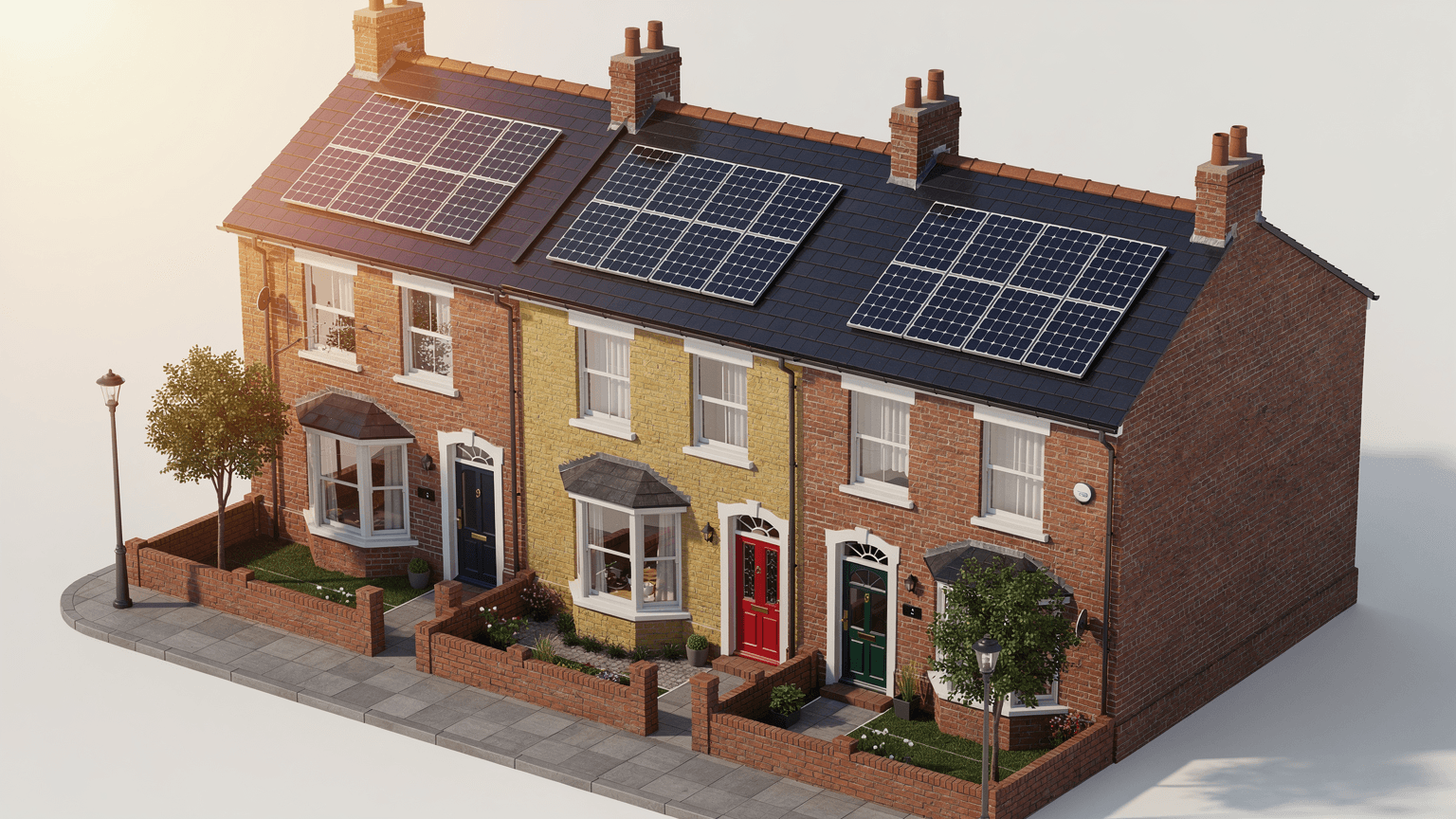
If you rent from a council or housing association, you may have noticed scaffolding and solar panels appearing on neighbouring streets. It is not a coincidence. England's social landlords are in the middle of the largest home-upgrade programme in decades, with government funding paying for solar panels on tens of thousands of social homes — and the electricity those panels generate goes to the tenant, free. This guide explains who pays, what you actually get, whether you can ask your council for panels, and what changes if you own your former council home. If you rent privately in a shared house instead, see our guide to solar panels on an HMO.
Why councils are installing solar panels now
Two forces are driving the rollout: money and a deadline. The money is the Warm Homes: Social Housing Fund (WH:SHF) — a £1.29 billion government pot (Wave 3, formerly the Social Housing Decarbonisation Fund) that councils, housing associations and other registered providers bid into to upgrade homes rated below EPC band C. Solar PV is an eligible measure, alongside insulation and low-carbon heating, and every install must use an MCS-approved product fitted by an MCS-certified installer. Grant funding averages up to £7,500 per home, delivery runs through 2028 (with co-funded projects allowed until March 2030), and since February 2026 landlords can also add home battery storage where it complements the solar. In April 2026 the government topped the fund up with a further £100 million, which it expects to deliver up to 57,000 solar installations for households in this financial year alone.
The deadline is EPC C by 1 April 2030. In its consultation response published in early 2026, the government confirmed that all social rented homes in England must reach EPC band C (or equivalent under the reformed EPC metrics) by April 2030 — and installing solar panels is explicitly listed as an eligible way to get there. Social housing already has the best energy-efficiency profile of any tenure — roughly three-quarters of England's 4.2 million social rented homes (1.6 million council, 2.6 million housing association) are already band C or above — but that still leaves around 1.2 million homes below C that landlords must upgrade this decade.
Behind both sits the wider Warm Homes Plan: £15 billion this Parliament to upgrade up to 5 million homes, with a stated aim of putting rooftop solar on up to 3 million more homes by 2030. A newer proposal — putting solar on council estates street by street rather than site by site — is under Treasury review; see our explainer on the street-by-street council solar plan for what has actually been put forward.
What solar panels mean for you as a tenant
You pay nothing, and you get free electricity whenever the panels are generating. Landlord-led schemes are grant-funded: WH:SHF guidance is explicit that tenants' energy bills must not increase as a result of the works. The panels are wired into your home's consumer unit, so daytime consumption — washing, cooking, charging, working from home — draws from the roof before it draws from the grid.
Real programmes give a sense of scale and value:
- Camden was awarded £13.5 million from WH:SHF Wave 3 in March 2026 to retrofit 3,000 council homes, with solar panels and battery storage in the first phase.
- Brighton & Hove has been fitting solar to around 800 council houses and bungalows, telling tenants they could save up to £250 a year on electricity.
- Waverley Borough Council in Surrey already has around 450 council homes with solar PV, with a contractor monitoring and maintaining the systems.
One thing tenants usually do not get is export income. Under Ofgem's Smart Export Guarantee, payments for surplus electricity go to the owner of the installation — and when your landlord funds and owns the panels, that is the landlord. Many social landlords use export income to help fund the programme itself. Your benefit is the free daytime electricity, which for most households is worth considerably more than the export payments would be.
Can you ask your council for solar panels?
Yes — and secure council tenants have a legal right behind the question. Under section 97 of the Housing Act 1985, it is a term of every secure tenancy that the tenant may make improvements with the landlord's written consent, and that consent must not be unreasonably withheld — if it is, the law treats it as given. An “improvement” is defined broadly as any alteration or addition to the dwelling-house, which covers a solar installation. (The right does not extend to flexible tenancies, and you would be paying for the system yourself — the right is to install, not to be funded.)
Housing association tenants on assured tenancies have no equivalent statutory right; whether you can install depends on your tenancy agreement, and Shelter's standing advice is to get your landlord's agreement in writing before starting any improvement. See the housing association section below for how eligibility and the application route differ from council tenancies.
In practice, the realistic route for most tenants is not a self-funded install but getting onto your landlord's programme. Contact your council's housing team (or your housing association) and ask three questions: does the landlord have Warm Homes: Social Housing Fund money or a solar programme; is your street or estate in a current phase; and what EPC rating does your home have on file — homes below band C are the priority pool. If your home is poorly rated and heated electrically, also ask about ECO4 (below).
Solar panels for housing association tenants
Housing association properties are eligible for the same landlord-funded solar programmes as council housing — the rules on asking are just different. The Warm Homes: Social Housing Fund is open to councils, housing associations and other registered providers alike, and housing associations manage the larger share of the sector: 2.6 million of England's 4.2 million social rented homes, against 1.6 million council homes. If your home is rated below EPC band C, it sits in the same priority pool for grant-funded solar as a council tenant's, and the terms are identical — the landlord pays, you keep the free daytime electricity, and your rent or service charge should not rise as a result of the works.
The difference is your legal position, not your eligibility for funding. Housing association tenants are almost always on assured tenancies rather than secure tenancies, so the section 97 Housing Act 1985 right to improve (with consent not unreasonably withheld) that applies to council tenants does not apply to you. Whether you can install panels yourself, or push for your home to be added to a programme, depends on what your tenancy agreement says about alterations — always get anything agreed in writing before work starts.
In practice, most housing association tenants get solar the same way council tenants do: by getting onto the landlord's existing retrofit programme rather than installing independently. To find out where you stand:
- Contact your housing association's asset management or sustainability team (sometimes called the retrofit or decarbonisation team) rather than general customer services — they hold the WH:SHF bid and phasing information.
- Ask what EPC band your home is on file — homes below band C are the ones being prioritised for solar and other measures under the 2030 deadline.
- Ask if your block or estate is in a current or upcoming WH:SHF phase, and whether battery storage is being added alongside solar (permitted since February 2026).
- Check your tenancy agreement's clause on alterations if you are considering funding a system yourself, and get your housing association's written consent regardless of who pays.
ECO4 — the other route for hard-to-heat social homes
ECO4 can fund solar on social housing, but only in narrow circumstances. The supplier-obligation scheme was extended in January 2026 and now runs to 31 December 2026. Social housing rated D to G can qualify for measures, but solar PV under ECO4 is a heating-linked measure: it is only eligible where the home's heating is (or becomes) a heat pump, high-heat-retention storage heaters or another efficient electric system — not a gas boiler — and capacity is capped at 10 kWp per home. If your council home is electrically heated and cold, it is worth asking your landlord specifically about ECO4 before the scheme closes. Our ECO4 guide covers eligibility in full.
Bought your council house? Different rules apply
Right-to-buy owners are private homeowners, and that opens doors tenants do not have. If you own a former council house, the Warm Homes: Local Grant can pay for solar panels in full: it covers privately owned homes rated EPC D to G where household income is £36,000 or less (or you receive qualifying benefits, or live in an eligible postcode), and the work is arranged and paid for by your local council at no cost to you. If your income is above that threshold, you still have funding options: interest-free solar finance or a green mortgage can cover the same install without the grant. You can also simply buy a system — see free and low-income solar grant routes for every option, or work through our UK solar installation guide for the full process from quote to switch-on. Before you commit your own money, it's worth weighing the full pros and cons of solar panels — the payback maths differs once you're paying installer prices rather than receiving a landlord-funded system. Our solar panel cost and savings guide breaks down installer prices by system size and what you can expect to save. Or use our solar panel calculator to size a system for your own roof and compare installed, self-install, and full DIY costs before you commit.
Our local area guides show city-specific generation estimates and connect you with MCS-certified installers in Leeds, Sheffield, York, Nottingham and Lincoln, among other areas.
If you own a former council flat, it is more complicated. Permitted development rights for solar do now extend to blocks of flats under the GPDO 2015 (Schedule 2, Part 14, Class A), so planning permission is often not needed — but in a typical flat lease the roof belongs to the freeholder, usually the council, so you need the freeholder's consent (a licence to alter) before anything is fixed to the building. Check your lease first. Some housing associations are now fitting whole-block shared systems instead of individual panels — see our guide to SolShare 2 shared solar for flats for how that works and who pays for it. E.ON Next launched a commercial version of this in September 2026, called FlatSave, already live at a Peabody Housing block.
Renting and impatient? Plug-in solar is coming
A no-drill, no-scaffolding option is close to reaching UK shops. In June 2026 the government consulted on amending the plug and socket safety regulations so that plug-in solar systems can legally connect straight into a standard mains socket, and ministers have said the panels — designed for balconies and small outdoor spaces — should be available within months. For tenants who cannot wait for a landlord programme, this is the most realistic self-serve route; our plug-in balcony solar guide tracks the rules as they land. Anything fixed to the building will still need your landlord's written permission, so freestanding or balcony-mounted kit is the safer choice while the rules settle.
The bottom line
Solar on council housing is overwhelmingly a landlord-led story: government money, a 2030 EPC deadline, and programmes measured in thousands of homes. As a tenant your best move costs nothing — ask your landlord where you sit in its plans. As a right-to-buy owner on a modest income, the Warm Homes: Local Grant may put panels on your roof for free. Either way, the direction of travel is clear: within a few years, solar on social housing will be unremarkable.
FAQs
Can council tenants get free solar panels?
Can I install my own solar panels in a council house?
Do council tenants get paid for electricity their solar panels export?
Do housing associations have to fit solar panels by 2030?
Sources — verified 4 July 2026
- GOV.UK, “Warm Homes: Social Housing Fund Wave 3” — www.gov.uk
- GOV.UK, “Warm Homes Plan” — www.gov.uk
- GOV.UK, “Improving the energy efficiency of socially rented homes in England: government response” — www.gov.uk
- GOV.UK, “Extending the ECO4 end date: government response” — www.gov.uk
- GOV.UK, “Apply for the Warm Homes: Local Grant” — www.gov.uk
- GOV.UK / DESNZ, “Britain embraces solar revolution following war in Iran” — www.gov.uk
- GOV.UK / DESNZ, “Plug-in solar: regulatory amendment and interim product specification (consultation)” — www.gov.uk
- GOV.UK, “English Housing Survey 2024 to 2025: profile of households and dwellings” — www.gov.uk
- Ofgem, “Smart Export Guarantee (SEG)” — www.ofgem.gov.uk
- Ofgem, “ECO4 Guidance: Delivery” — www.ofgem.gov.uk
- legislation.gov.uk, “Housing Act 1985, section 97 — tenant's improvements” — www.legislation.gov.uk
- legislation.gov.uk, “Town and Country Planning (General Permitted Development) (England) Order 2015 — Schedule 2, Part 14” — www.legislation.gov.uk
- Camden Council, “Cheaper bills for 3,000 council homes to come following retrofit investment” — news.camden.gov.uk
- Brighton & Hove City Council, “Hundreds of council homes to switch to solar power” — www.brighton-hove.gov.uk
- Waverley Borough Council, “Solar panels on council homes” — www.waverley.gov.uk
- Shelter England, “Making improvements to your rented home” — england.shelter.org.uk

About the author
Sepehr
Solar specialist & co-founder, Smart Solar Homes
Solar specialist and co-founder of Smart Solar Homes, which works with MCS-certified UK installer partners. I write all the guides and reviews here; the aim is straight-talking education the industry rarely provides.
Citing this page? Please use a dofollow link back to the original article — it helps us keep the data on this page accurate and up to date.
Browse Solar Panels on Smart Solar Homes


Want to compare these side by side? Use the compare tool →
Or browse all Solar Panels on Smart Solar Homes.
Related reading
More on solar panels from the editorial team.

Find installers near you
MCS-certified solar installers covering these areas.