Home Battery Storage UK: The Complete Guide (2026)
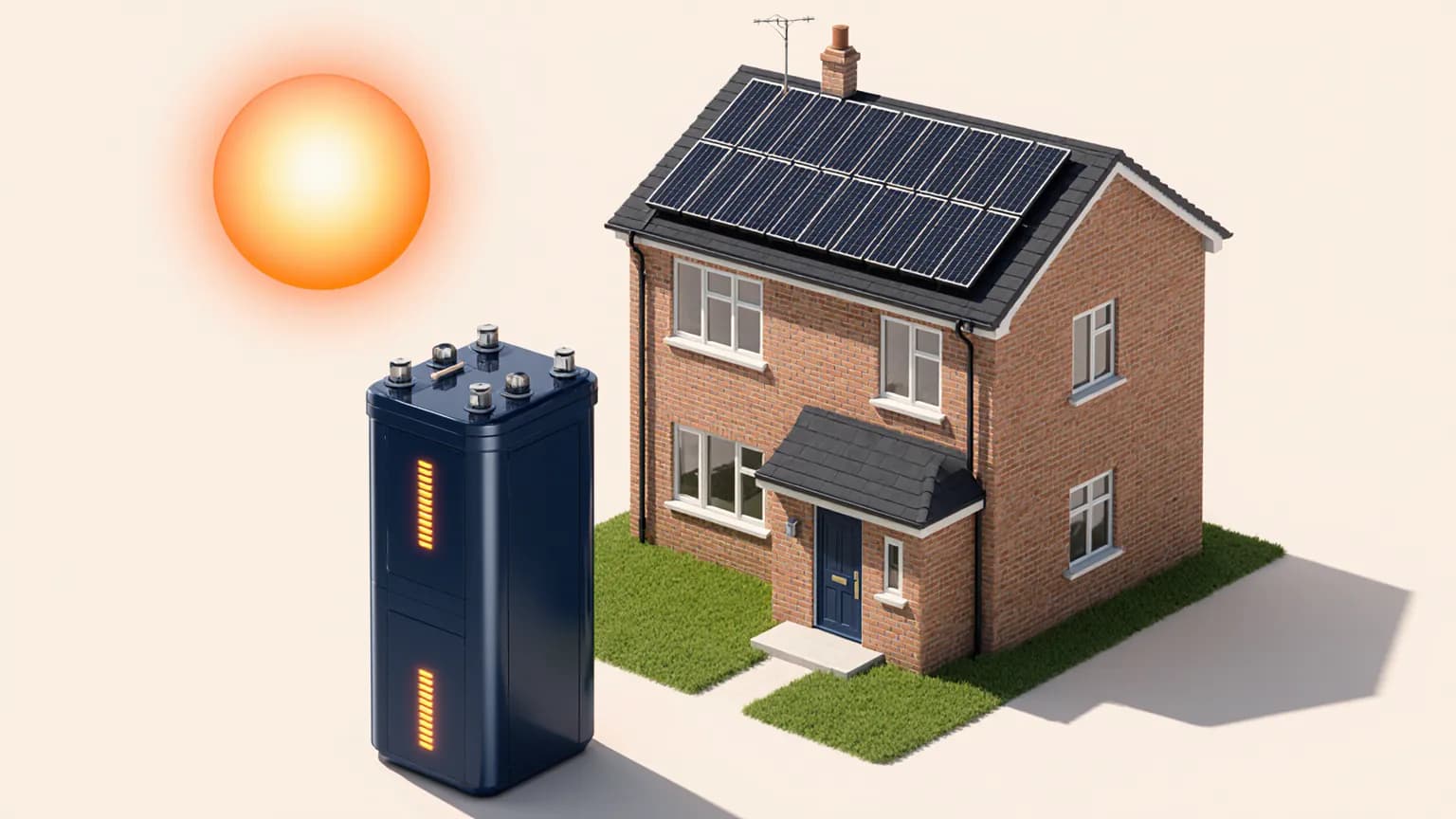
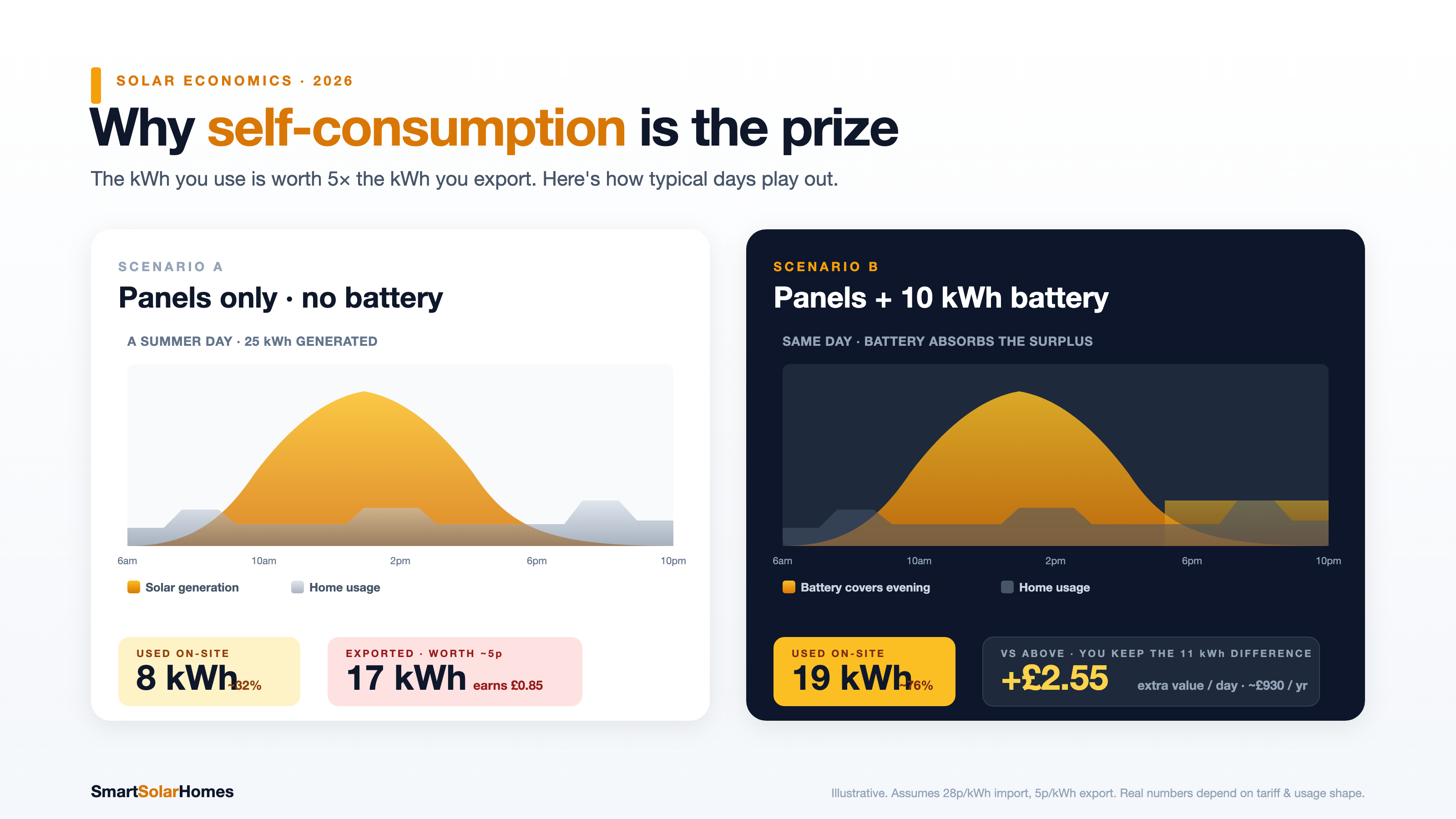
A home battery lets you store the solar electricity you generate during the day and use it in the evening, when your panels have stopped producing but your household demand is highest. Done well, it can lift solar self-consumption from around 50% to above 80%, cutting the amount you import from the grid at what are currently 24–28p/kWh rates. Done poorly — wrong size, wrong coupling type, or a battery with a weak warranty — it adds cost without adding much value. This guide covers everything you need to make a clear-headed decision: how batteries work with solar, AC versus DC coupling, the three specifications that actually matter, sizing, honest payback expectations, battery chemistry, warranties, and what to ask an installer before you sign anything.
How a home battery works with solar
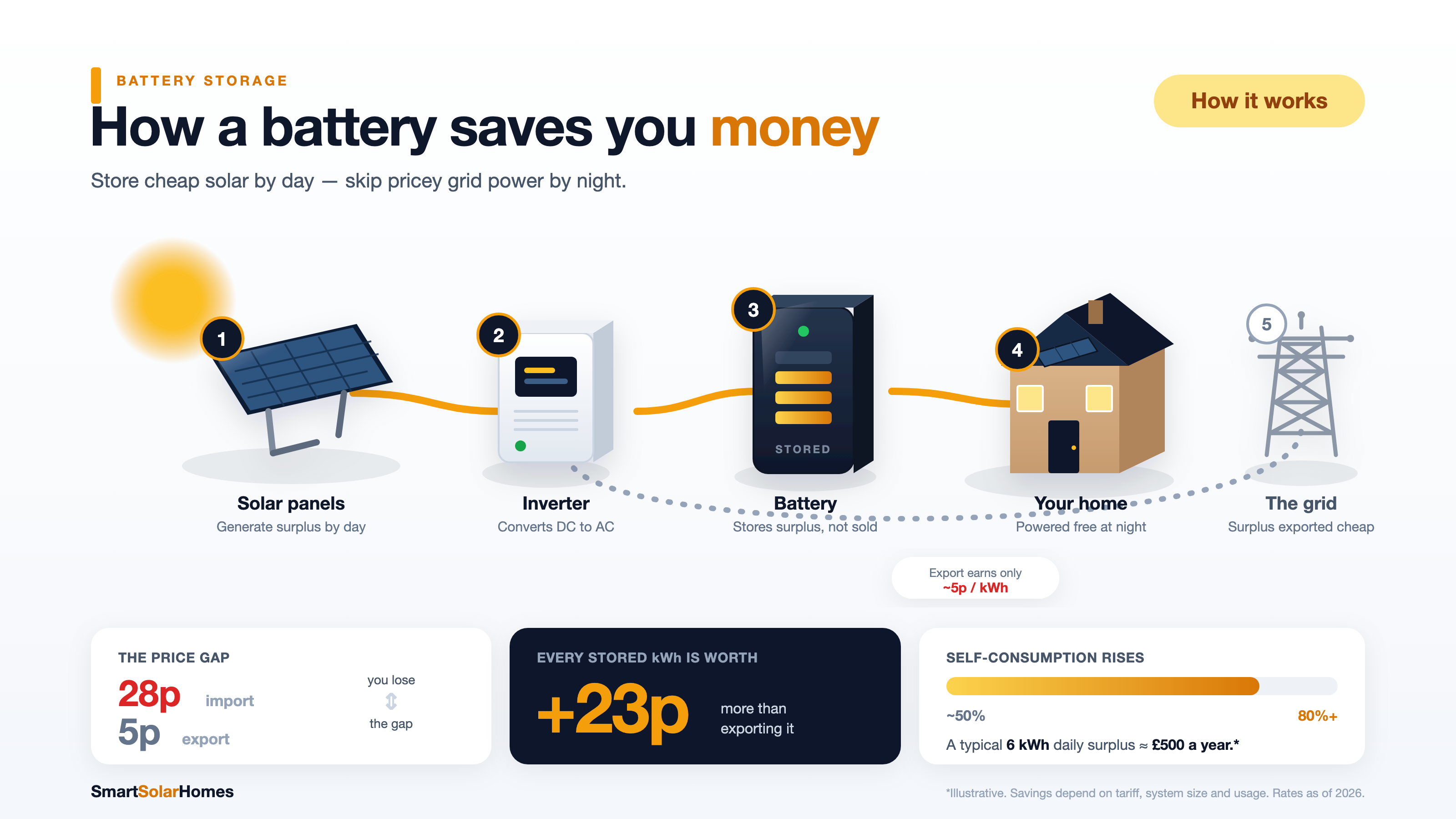
Your solar panels produce DC electricity. Your inverter converts it to AC for use in your home. Without a battery, any surplus AC electricity flows out to the grid — you typically receive around 4–5p/kWh for it via the Smart Export Guarantee, far less than the 24–28p/kWh you pay to import. A battery intercepts that surplus and stores it so you can use it later.
The battery's job is simple: charge during solar surplus, discharge during household demand. How it connects to your solar system — the coupling type — determines efficiency, cost, and compatibility with your existing setup.
AC coupling versus DC coupling
This is the most important technical decision, and it's largely made for you by whether you're adding a battery to an existing installation or starting fresh.
DC coupling connects the battery before the inverter, on the DC side of your panels. It requires a hybrid inverter — a single unit that manages both solar and battery simultaneously. Because electricity flows from panel to battery without ever being converted to AC and back, DC-coupled systems are inherently more efficient. The GivEnergy All-in-One and the Tesla Powerwall 3 are both DC-coupled with integrated hybrid inverters. DC coupling is the standard choice for new installations.
AC coupling adds the battery on the AC side of an existing inverter. It works by fitting a separate battery inverter alongside your solar inverter. This makes retrofitting straightforward — you don't need to replace your existing solar inverter — but every charge and discharge cycle involves an extra AC/DC conversion step, which costs a few percentage points of efficiency. The Powervault 4 is an AC-coupled system designed specifically for this kind of retrofit, and its British manufacture and customer support reputation are genuine strengths.
For a fuller discussion of whether you need a battery at all with your current setup, the solar installation guide section on batteries works through the retrofit question in detail.
The three specifications that matter
Battery datasheets are full of numbers. Most of them are marketing. These three are the ones worth scrutinising.
Usable capacity (not gross)
Manufacturers quote gross capacity (the physical size of the battery) and usable capacity (how much you can actually store and retrieve). The gap is typically 5–10%. Always compare usable figures — a battery listed as 10kWh gross may deliver only 9.5kWh in practice. For sizing your battery to your actual needs, usable capacity is the only number that matters.
Round-trip efficiency
Round-trip efficiency measures how much of the electricity you put in comes back out. Put in 10kWh; get back 9.7kWh at 97% efficiency, or 9.5kWh at 95%. Scrutinise anything below around 92% — it means you're losing a meaningful amount of energy on every cycle, which erodes the financial case. DC-coupled systems with good lithium iron phosphate (LFP) chemistry typically achieve 95–97.5%.
Cycle warranty
A battery warranty expressed in years can be misleading on its own. What matters is how many charge/discharge cycles the manufacturer guarantees. Cycling once per day over ten years is roughly 3,650 cycles; over fifteen years, around 5,475. A warranty of 6,000 cycles is meaningfully better than one of 4,000 cycles, even if both products carry a ten-year term. Check the small print: many warranties include a capacity retention clause (e.g. the battery must still deliver at least 70% of original capacity at end of warranty).
Battery chemistry: why LFP dominates
Virtually every battery worth buying for home storage in 2026 uses lithium iron phosphate (LFP) chemistry rather than the NMC (nickel manganese cobalt) chemistry found in older EV and laptop batteries. LFP is thermally stable — it doesn't suffer the same fire risk as NMC under overcharge or physical damage conditions — and it handles deep cycling better, retaining capacity over more cycles. It is slightly heavier and less energy-dense than NMC, but those trade-offs are irrelevant for a wall-mounted home unit.
The full explanation of why battery chemistry matters for home storage covers the electrochemical differences in plain language if you want to understand the detail before committing to a purchase.
Sizing: match the battery to your surplus, not your consumption
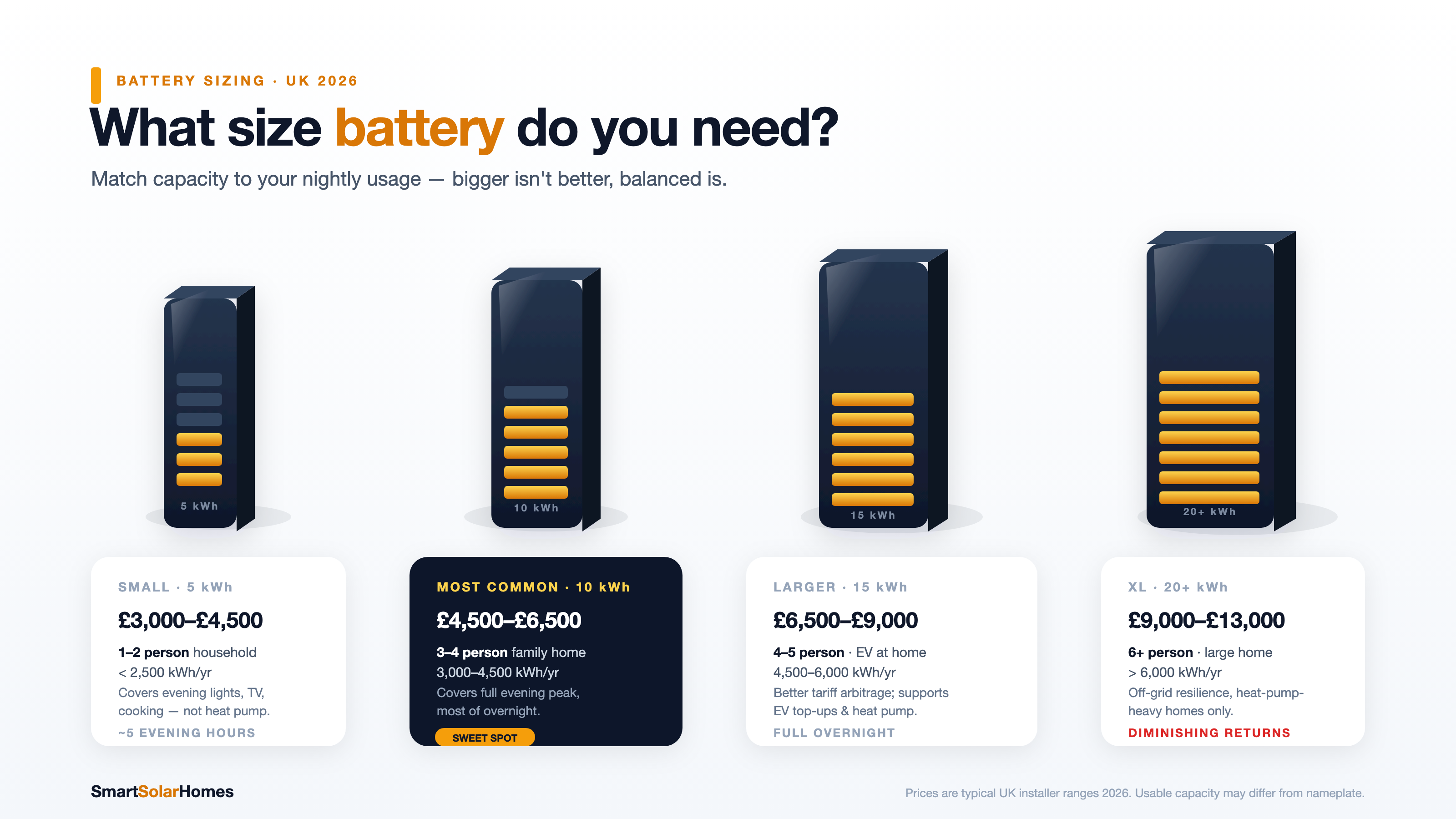
The most common sizing mistake is buying a battery large enough to cover total daily household consumption. That's the wrong reference point. A battery can only store electricity your panels have generated but not yet used — your solar surplus. If your panels produce 12kWh on a typical sunny day and your household uses 6kWh of that as it's generated, your daily surplus is around 6kWh. A 13.5kWh battery sits half-empty every morning.
A typical UK home uses around 10kWh per day, but solar surplus varies enormously by system size, orientation, shading, and the time of year. The right starting point is your actual generation and consumption data, not a rule of thumb. The home battery sizing guide walks through this calculation with worked examples and explains when it makes sense to size up for future demand — an EV, a heat pump — rather than today's surplus alone.
Modular systems like the Fox ESS H3 let you start with a smaller capacity and add modules as your needs change, which reduces the risk of over-specifying upfront.
Costs and payback: an honest picture
Battery storage costs have fallen considerably over the past five years, but they remain a significant investment. For a detailed breakdown of what you'll actually pay, the home battery cost guide covers price by capacity, what drives the variation, and VAT.
The headline: VAT on battery storage has been zero-rated since April 2022, which meaningfully reduces the installed cost. A mid-range DC-coupled system with a hybrid inverter typically runs from around £4,800 to around £8,500 installed, depending on capacity and brand.
On payback: a battery's primary financial value is avoiding grid imports at 24–28p/kWh. It does not shorten the payback period of your solar installation — it extends it slightly, because the battery itself has a cost to recover. What it does do is make your solar investment work harder: more of what you generate gets used at home rather than exported cheaply. The secondary value is time-of-use tariff arbitrage: on Octopus Agile or similar tariffs, a battery can charge on cheap overnight rates and discharge during expensive peak periods. That is a separate income stream from solar but depends on how actively you want to manage your system. For the broader solar financial picture, the solar panel cost and savings guide covers the full context.
Product shortlist
The best home battery storage roundup for 2026 covers the full shortlist with detailed assessments. Here is a brief overview of the leading options.
GivEnergy All-in-One — 8.2kWh usable, DC-coupled with hybrid inverter included, around £5,500 installed, ~97% round-trip efficiency, 12-year warranty. The most polished UK-focused package at this price point. See the GivEnergy AIO product page for full specifications.
Tesla Powerwall 3 — 13.5kWh usable, DC-coupled, integrated inverter, around £8,500 installed, ~97.5% efficiency. The highest usable capacity in the mainstream market and the strongest round-trip efficiency figure. See the Tesla Powerwall 3 product page for full specifications.
Fox ESS H3 + ECS2900 — around 10kWh usable, around £4,800 installed, ~95.5% round-trip efficiency, 6,000-cycle warranty, modular design. The most attractive option if budget is a priority and you value modularity. See the Fox ESS H3 product page.
Powervault 4 — from around £3,200, British-made, AC-coupled retrofit. Lower round-trip efficiency than the DC-coupled competition but the most straightforward retrofit option. See the Powervault 4 product page.
For head-to-head comparisons: GivEnergy AIO versus Tesla Powerwall 3 and Fox ESS H3 versus GivEnergy AIO cover the key trade-offs in detail. The editorial reviews at Fox ESS vs GivEnergy and GivEnergy AIO vs Tesla Powerwall 3 give broader context beyond the spec sheets. You can also browse the full battery storage product catalogue.
Warranties in practice
Most batteries carry a 10–12 year product warranty, sometimes expressed as a capacity retention guarantee rather than a straight replacement promise. Read carefully: “70% capacity retention at 10 years” means the manufacturer will replace or compensate only if the battery falls below 70% of its original usable capacity. If it degrades to 75%, you're not covered even though the battery is noticeably worse than new. The Fox ESS ECS2900's 6,000-cycle warranty is notable because it is expressed in cycles rather than years alone, which is a more meaningful metric for how you actually use a battery.
Also check: who services the warranty in the UK? Products backed by a UK-based team or authorised UK service network are considerably less hassle if something goes wrong in year seven.
What to ask an installer
Before agreeing to any installation, get clear answers to these questions.
- AC or DC coupling? If you have an existing solar inverter, confirm whether the installer plans to replace it (DC coupling) or add an AC-coupled battery alongside it. Both are valid; you just need to know which and why.
- Which hybrid inverter? For DC-coupled systems, the inverter is bundled with the battery or sold alongside it. Confirm the brand, model, and warranty period for the inverter separately from the battery.
- DNO notification. Batteries above 3.68kW export capacity require notification to your Distribution Network Operator. Ask whether the installer handles this as part of the installation.
- G99 or G98? Most domestic batteries operate under G98 (self-notification) but confirm this for your specific system. G99 requires prior approval and can add weeks to a project timeline.
- Monitoring and tariff optimisation. Does the inverter integrate with your energy tariff for smart charging? This is increasingly standard but not universal — confirm it works with your tariff before signing.
- MCS certification. The installer should hold MCS accreditation or work under an MCS-certified company. This is required for Smart Export Guarantee registration and is a minimum quality benchmark.
Batteries and EVs
If you own or plan to buy an electric vehicle, a home battery changes the solar economics significantly. A battery can store daytime solar surplus and then charge your EV in the evening from stored solar rather than grid electricity, or it can work alongside a smart EV charger to manage when and how fast the car charges based on solar generation and tariff rates. The EV charging with solar guide covers the interaction between batteries, smart chargers, and solar in detail.
FAQs
Can I add a battery to an existing solar installation?
Yes. AC-coupled batteries retrofit onto any existing solar inverter without replacing it. DC-coupled batteries require replacing your solar inverter with a hybrid inverter, which adds cost but gives better efficiency. The right choice depends on the age and condition of your existing inverter.
Does a battery work during a power cut?
Only if your battery and inverter system includes islanding or backup power capability, which must be explicitly supported by the hardware and enabled during installation. Not all systems support it. Ask specifically; do not assume.
Is battery storage VAT-free?
Yes. Battery storage has been zero-rated for VAT since April 2022, when installed alongside a solar system or as a standalone retrofit. This applies to both the battery and installation labour.
What happens at the end of the battery's life?
LFP batteries degrade slowly rather than failing abruptly. At end of warranty, a battery that has been cycled daily typically still holds 70–80% of its original capacity and can continue operating in a reduced-capacity role. When it eventually needs replacing, the cell modules can be recycled; the inverter and balance-of-plant equipment may outlast several battery generations.
Where to go next
If you're working through the decision systematically: start with sizing to establish what capacity you actually need, then review typical costs to sense-check your budget, then look at the product shortlist to narrow down options. When you're ready to move forward, get quotes from MCS-certified installers — comparing at least three quotes is standard practice and regularly surfaces meaningful price differences.