Fox ESS H3 vs GivEnergy AIO: Which Battery Wins in 2026?

Written and reviewed by Sepehr. See our editorial policy.
Fox ESS and GivEnergy are the two batteries most likely to land in your inbox if you ask for quotes from UK MCS-certified installers in the £4,500–£6,000 range. On paper they're more similar than not. In practice the differences matter — modularity, app maturity, warranty cycle terms, and round-trip efficiency each tilt the choice depending on your priorities.
This is a head-to-head comparison from the spec sheets through to what you'll actually live with for the next 12 years.
For a deeper dive on Fox ESS on its own, see our Fox ESS EP5 review.
Quick verdict
- Choose GivEnergy All-in-One if: you want a single tidy floor-standing unit (13.5 kWh in one box), the simplest install possible, a long 12-year warranty (70% capacity retention per GivEnergy's warranty terms), and you trust UK-designed hardware backed by a UK service team.
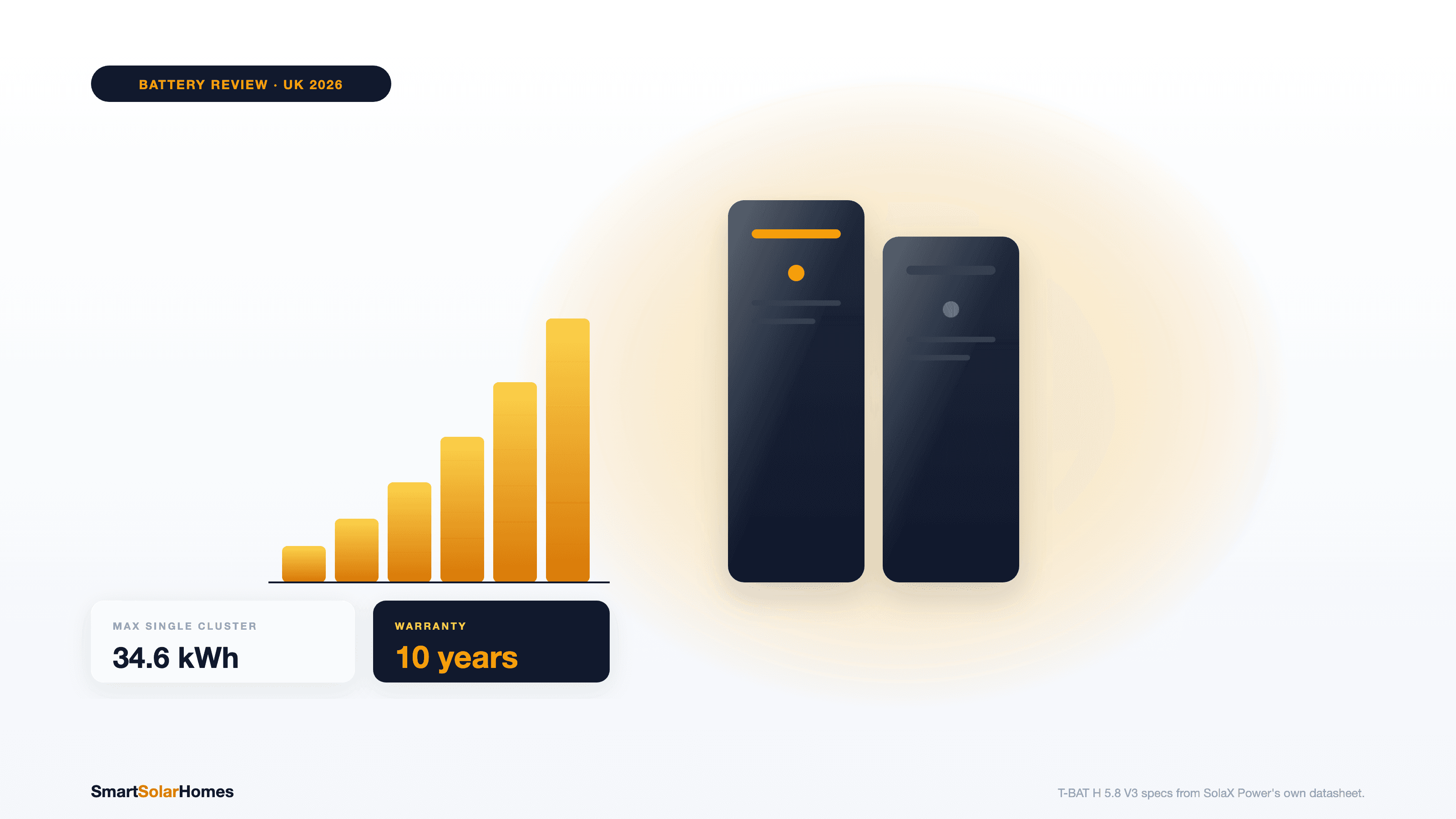
- Choose Fox ESS H3 + ECS2900 if: you want modular capacity (start at 5.8 kWh, grow to 17.4 kWh by adding modules), the lowest entry cost, and a 6,000-cycle warranty term that protects against active tariff arbitrage usage.
Spec sheet head-to-head
Usable capacity
GivEnergy All-in-One: 13.5 kWh usable (fixed, single unit, 100% depth of discharge)
Fox ESS H3 + 2× ECS2900: 5.8 kWh starter, up to 17.4 kWh with 6 modules
Battery chemistry
Both: LFP (lithium iron phosphate) — the right choice for home storage
Round-trip efficiency
GivEnergy AIO: ~93% system round-trip (manufacturer figure for the Gen-1 All-in-One)
Fox ESS H3 + ECS2900: ~93-94% system round-trip (battery datasheet)
Coupling
Both: DC-coupled with integrated hybrid inverter
Hybrid inverter capacity
GivEnergy AIO: 6 kW (single-phase only)
Fox ESS H3: 3.0/3.7/5.0/6.0 kW versions available
Max continuous discharge
GivEnergy AIO: 6 kW
Fox ESS H3: matches inverter spec (5 kW typical)
Warranty
GivEnergy AIO: 12 years, 70% capacity retention (per GivEnergy's residential warranty terms)
Fox ESS ECS2900: 10 years OR 6,000 cycles, whichever comes first, with 80% capacity retention
Installed cost (typical 2026 MCS quote)
GivEnergy AIO: around £5,500
Fox ESS H3 + 3 modules (8.7 kWh): around £4,800
Fox ESS H3 + 4 modules (11.6 kWh): around £5,400
Physical install
GivEnergy AIO: floor-standing single unit, ~174 kg, requires solid floor + wall behind
Fox ESS H3 + ECS2900: stacked modular tower, around 35 kg per module, can split inverter and battery locations
Country of origin
GivEnergy: UK-designed (Newmarket, Cambridgeshire), cells manufactured in China
Fox ESS: Chinese-manufactured, UK distributor with established service network
Where each one wins
GivEnergy wins on simplicity
One box. One brand. One warranty. The All-in-One arrives as a finished product and is installed against a wall in a few hours by an experienced installer. There is nothing to specify, no module count to debate, no risk of a coupling mismatch between battery and inverter.
For homeowners who want to make a decision once and move on, this matters. The 12-year warranty (70% capacity retention under GivEnergy's terms) is also among the longest single warranties in the UK mid-market — Fox's cycle terms are theoretically stronger but only if you cycle aggressively. For a typical single-cycle-per-day household, GivEnergy's 12 years is a strong deal on paper.
Round-trip efficiency: closer than the marketing suggests
Both systems sit in the same band on paper. GivEnergy quotes roughly 93% system round-trip for the Gen-1 All-in-One, and the Fox ECS2900 battery comes in around 93-94%. Manufacturers measure efficiency differently (battery-only vs. battery-plus-inverter), so head-line numbers aren't strictly comparable, and real-world figures depend on charge/discharge rate and temperature.
The practical takeaway: any efficiency gap here is small — a percentage point or two of round-trip loss across a year is a few tens of kWh, well inside the noise of installer wiring quality and household usage patterns. Don't pick between these two on efficiency alone.
Fox ESS wins on modularity
The H3 + ECS2900 system lets you size to your actual needs and grow later. The minimum useful config is one ECS2900 module (2.9 kWh — too small for most), but two modules (5.8 kWh) suits a small home or a household that wants to test before scaling.
Six modules give 17.4 kWh, which is more than any GivEnergy single unit can deliver and competitive on price-per-kWh at scale. If your household is likely to add an EV or heat pump in the next five years, starting at 8.7 kWh and adding a fourth module later costs around £900 — much cheaper than buying a second 13.5 kWh AIO and integrating it.
Fox ESS wins on warranty cycle terms
The 6,000-cycle warranty is the strongest in the UK market. For households on Octopus Agile or Cosy Octopus that actively arbitrage (charge cheaply, discharge during peak), batteries can cycle 1.5–2x per day. A single-cycle warranty term protects them; a years-based term might run out long before the battery does.
For a normal single-cycle-per-day household, this advantage is theoretical. For an Agile household, it's genuinely valuable insurance.
Fox ESS wins on physical install flexibility
Wall-mountable, stackable modules. The inverter can sit in one location, the battery modules in another. For homes with an awkward utility room, a small garage, or a tight under-stairs cupboard, the Fox tends to fit where the GivEnergy slab can't.
App and monitoring
The GivEnergy app and cloud portal have improved significantly through 2024–2026 but still occasionally lag real-time data and have intermittent sync issues, particularly under load. The set-and-forget user won't notice; the engaged user who wants minute-by-minute insight will.
The Fox ESS app is functional and reliable but plainer. The interface is less polished than GivEnergy's or Tesla's. Reporting is adequate, not delightful.
Neither is a deal-breaker. For Octopus tariff integration, both work with Octopus Intelligent and Cosy via third-party integrations (Hildebrand Glow, ev.energy) but Tesla and Indra still lead on first-party tariff hooks.
Real-world reliability
GivEnergy has had warranty-handling issues over 2023–2024 when their volume scaled faster than their service capacity. By late 2025 the service team had stabilised, and current return-times for warranty replacements are within a few weeks. Reputation-wise, the GivEnergy ecosystem is robust but had a bumpy adolescence.
Fox ESS has a thinner but quieter track record in the UK. Distributor-led warranty claims have generally been handled well. The unit count in the field is lower, so there's simply less data — that cuts both ways.
Backup power
Both can provide backup power during outages, but neither is standard:
- GivEnergy AIO requires the EPS (Emergency Power Supply) module, which adds around £400 to the install and provides whole-home backup of essential circuits.
- Fox ESS H3 supports backup via the dedicated EPS port — requires a sub-board with backup circuits identified, adding £300–£500 to the install.
If backup is a priority and the budget allows it, Tesla Powerwall 3 has the most polished implementation — see the GivEnergy vs Tesla comparison.
Total cost of ownership over 12 years
Roughly modelled, for a 4,000 kWh-consumption household with 5 kWp solar and standard tariff:
- GivEnergy AIO (13.5 kWh): £5,500 installed; estimated £7,000–£7,500 savings over 12 years from the larger usable capacity; net benefit around £1,500–£2,000.
- Fox ESS H3 + 3 modules (8.7 kWh): £4,800 installed; estimated £6,000 savings over 12 years; net benefit around £1,200.
On a like-for-like usable-capacity basis the GivEnergy's larger 13.5 kWh pack tends to capture more solar self-consumption, so it can edge ahead on lifetime savings despite the higher upfront price; the Fox wins on lowest entry cost and £-per-kWh if you start small. The GivEnergy also benefits from its 12-year warranty in years 11–15. These figures are illustrative — your own usage, tariff and solar size dominate the result, so run the numbers for your home. Any surplus solar generation that your battery cannot store can be exported to the grid under the Smart Export Guarantee (SEG), regulated by Ofgem — rates vary by supplier but add a further income stream on top of self-consumption savings.
Both compare favourably to no battery; both pay back during the warranty period under current grid pricing.
Installer availability
GivEnergy has the widest MCS-certified installer network in the UK — virtually any reputable solar installer will quote it. Fox ESS is well-supported but with a smaller installer pool, so quotes may come back from a narrower set of companies.
This matters less than it sounds. The big determinant of install quality is the installer, not the battery brand. A good installer using Fox is preferable to a mediocre installer using GivEnergy.
Where to go next
See full pricing and specs on the GivEnergy All-in-One product page. For the broader landscape, see best home battery storage UK 2026. For a higher-end alternative comparison, see GivEnergy AIO vs Tesla Powerwall 3. For the full home battery decision framework, see the home battery storage guide. To compare specs side by side, use the compare tool. When you're ready, request quotes from MCS-certified installers.
FAQs
Is Fox ESS as reliable as GivEnergy?
Comparable reliability in field reports; Fox has fewer units installed in the UK so the dataset is smaller. Neither has shown chronic failures in domestic deployments.
Can I mix Fox ESS modules with a different battery brand?
No. The ECS2900 modules are matched to the H3 hybrid inverter via Fox's BMS communication protocol. They will not pair with other manufacturers.
Which is easier to install?
Fox is easier in tight spaces (modular, lighter) but adds component count. GivEnergy is easier conceptually (one box) but harder physically (145 kg unit). Skilled installers handle both routinely.
Which one supports Octopus Agile?
Both, via third-party integrations. Neither has a first-party Agile-aware control mode as of 2026 — that distinction is held by Tesla, Indra, and the now-discontinued myenergi Libbi 5.
What happens at end of warranty?
LFP chemistry degrades gracefully. Both batteries should hold around 70–80% of original capacity at end of warranty and can continue operating in reduced-capacity mode for several more years. End-of-life recycling is handled by the original manufacturer in the UK.
Sources — verified 4 June 2026
- GivEnergy, “All in One — product page” — givenergy.com
- GivEnergy, “All in One (6kW AC-coupled) datasheet” — givenergy2025.zohodesk.eu
- GivEnergy, “Residential Product Warranty (12-year)” — givenergy.co.uk
- Fox ESS, “ECS2900 high-voltage storage battery datasheet” — za.fox-ess.com
- Fox ESS, “Battery products” — www.fox-ess.com
- Ofgem, “Energy price cap (1 April – 30 June 2026)” — www.ofgem.gov.uk
- MCS (Microgeneration Certification Scheme), “Find an MCS certified installer” — mcscertified.com
- Ofgem, “Smart Export Guarantee (SEG)” (grid export scheme for solar and battery households) — www.ofgem.gov.uk

About the author
Sepehr
Solar specialist & co-founder, Smart Solar Homes
Solar specialist and co-founder of Smart Solar Homes, which works with MCS-certified UK installer partners. I write all the guides and reviews here; the aim is straight-talking education the industry rarely provides.
Citing this page? Please use a dofollow link back to the original article — it helps us keep the data on this page accurate and up to date.
Browse Battery Storage on Smart Solar Homes


Want to compare these side by side? Use the compare tool →
Or browse all Battery Storage on Smart Solar Homes.
Related reading
More on battery storage from the editorial team.
Find installers near you
MCS-certified solar installers covering these areas.