Boiler Upgrade Scheme Budget 2026: Funding Maintained
Written and reviewed by Sepehr. See our editorial policy.
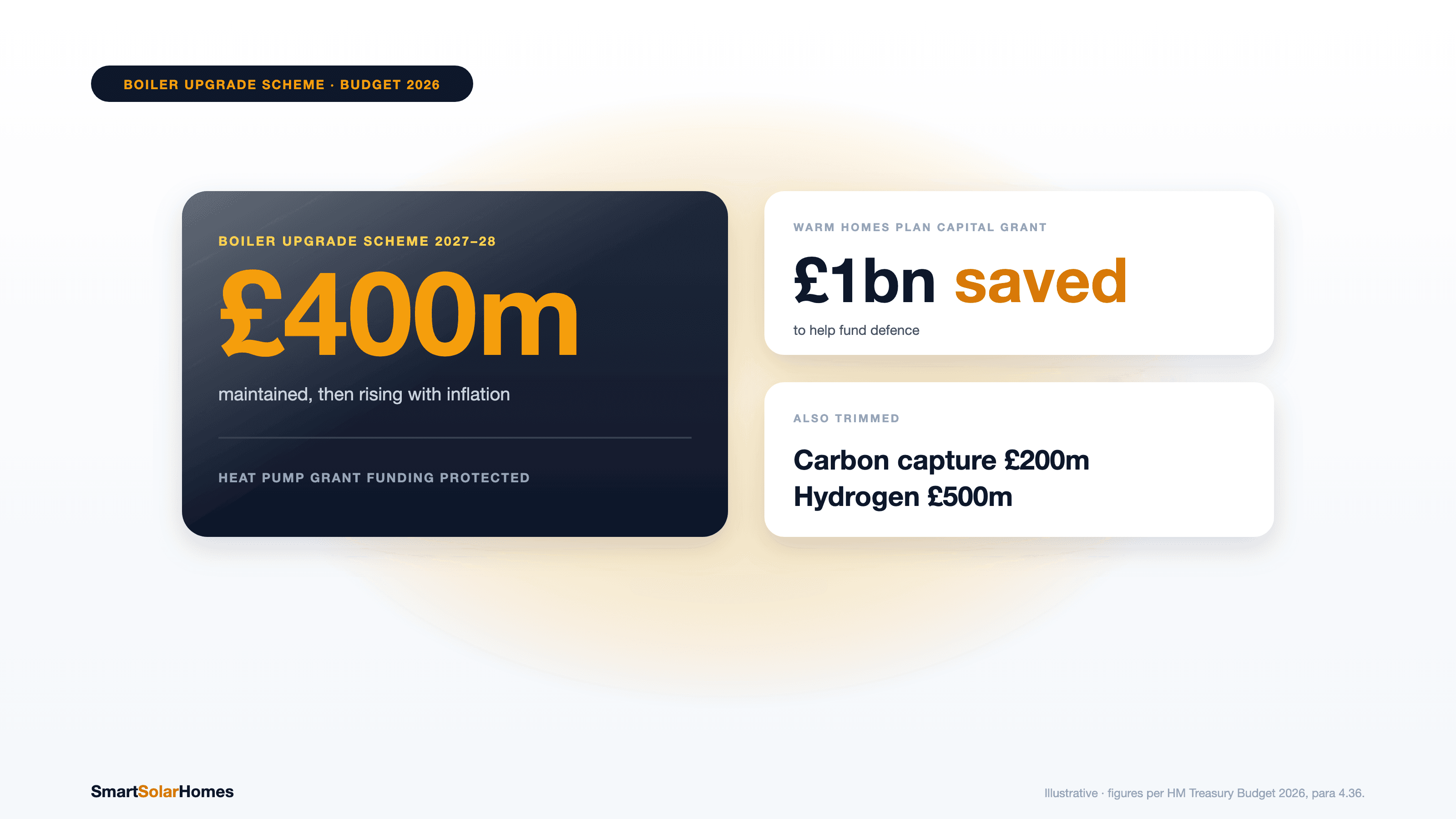
The Boiler Upgrade Scheme is not being cut in Budget 2026. The Treasury's Budget document says the government will “maintain the Boiler Upgrade Scheme at current funding levels of £400 million in 2027‑28 and rising broadly in line with inflation thereafter”. The rumours that ministers would raid the heat pump grant to pay for defence were half right, though: the money did come out of the energy department's budget, but from a different programme, the Warm Homes Plan. Here is what the document actually says, and what it means if you are planning a heat pump.
The rumour
In October, reports citing the Guardian said ministers were looking to take hundreds of millions of pounds from the scheme's roughly £2.7bn budget to help fund higher defence spending, and industry groups publicly urged the government not to do it (see, for example, The Eco Experts and UKEM). The energy department did not confirm a cut. It was reported as saying the savings it needed to find were a small part of its overall budget, and that the government would set out how it funds national security investment this autumn.
What the Budget document says
Paragraph 4.36 of the Treasury's Budget 2026 document covers it directly. It says the Department for Energy Security and Net Zero (DESNZ) is “reprioritising its budget to contribute towards the Defence Investment Plan”, and sets out where the money comes from:
- Warm Homes Plan: £1 billion of capital grant saved.
- Hydrogen: £500 million saved.
- Carbon capture, usage and storage: £200 million of capital grant saved.
- Great British Energy: a £200 million saving, with £8.3 billion retained across the spending review period.
The same paragraph says the government “remains committed to heat pump deployment” and keeps the Boiler Upgrade Scheme at £400 million in 2027‑28, rising broadly with inflation after that. It also notes that the Warm Homes Loan Scheme has launched to support heat pump and clean technology uptake, and that the majority of Warm Homes Plan funding for low-income households and social housing, delivered by mayors and councils, is protected.
What the Warm Homes Plan cut means
The Warm Homes Plan is the wider programme that covers grants for low-income households, social housing and the new loan scheme. Our Warm Homes Plan guide describes it as a £15 billion commitment published in January 2026; that headline was set before this Budget, and the Budget document does not restate the total after the £1 billion saving, so we have not recalculated it.
Separately, the Treasury says the £4.7bn Your First Home equity loan scheme is funded by reprioritising departmental financial transactions, with DESNZ reallocating money “including from the Warm Homes Fund”. The document does not say how that affects the Warm Homes Loan Scheme, which our explainer describes as funded from that pot, so watch for detail on lender capacity.
What the Budget does not tell you
- Grant levels: the document gives funding, not per-installation rates. The current £7,500 grant for an air source or ground source heat pump is unchanged by it, as is the temporary £9,000 rate for oil and LPG homes that runs to 31 March 2027; see our air source heat pump grant guide.
- How long “thereafter” lasts: funding is stated for 2027‑28 and described as rising broadly in line with inflation after that, with no end date given.
- The demand picture: it is a demand-led scheme, so the funding figure is a budget envelope rather than a promise about every voucher.
What to do if you are planning a heat pump
The cut rumour is not a reason to rush. The grant is funded and the rates have not changed. The date that does matter is 31 March 2027, when the £9,000 uplift for off-gas-grid homes is scheduled to end. If that applies to you, plan your survey and quote with that deadline in mind, and confirm in writing that your installer's price already deducts the voucher. For running costs after the grant, see heat pump running costs, and for what else the Budget changed on energy bills, read our Budget 2026 energy changes summary.
FAQs
Is the Boiler Upgrade Scheme being cut in 2026?
How much is the heat pump grant after the Budget?
What did the Budget cut from the Warm Homes Plan?
Should I apply for the heat pump grant before it changes?
Sources — verified 28 October 2026
- HM Treasury, “Budget 2026 (HC 726), paragraphs 4.36 and 5.7” — assets.publishing.service.gov.uk
- GOV.UK, “Budget 2026 document” — www.gov.uk
- GOV.UK, “Apply for the Boiler Upgrade Scheme: What you can get” — www.gov.uk
- The Eco Experts, “'Don't cut the Boiler Upgrade Scheme!' Industry experts slam govt plans” — www.theecoexperts.co.uk
- UKEM, “Boiler Upgrade Scheme Cut? What the Reports Mean” — www.ukem.co.uk

About the author
Sepehr
Solar specialist & co-founder, Smart Solar Homes
Solar specialist and co-founder of Smart Solar Homes, which works with MCS-certified UK installer partners. I write all the guides and reviews here; the aim is straight-talking education the industry rarely provides.
Citing this page? Please use a dofollow link back to the original article — it helps us keep the data on this page accurate and up to date.
Browse Solar Panels on Smart Solar Homes


Want to compare these side by side? Use the compare tool →
Or browse all Solar Panels on Smart Solar Homes.
Related reading
More on solar panels from the editorial team.

Find installers near you
MCS-certified solar installers covering these areas.