Step 4 of 6
Add a battery (optional)
A battery stores surplus generation during the day for use in the evening. It is not always the best financial decision — read below before you decide.
When a battery makes sense
A battery pays back fastest if you are home during the day (and would otherwise export surplus at a low SEG rate) and have significant evening usage. If you already have an EV and a time-of-use tariff, the tariff arbitrage alone often closes the gap on a battery's payback period.
How to size it
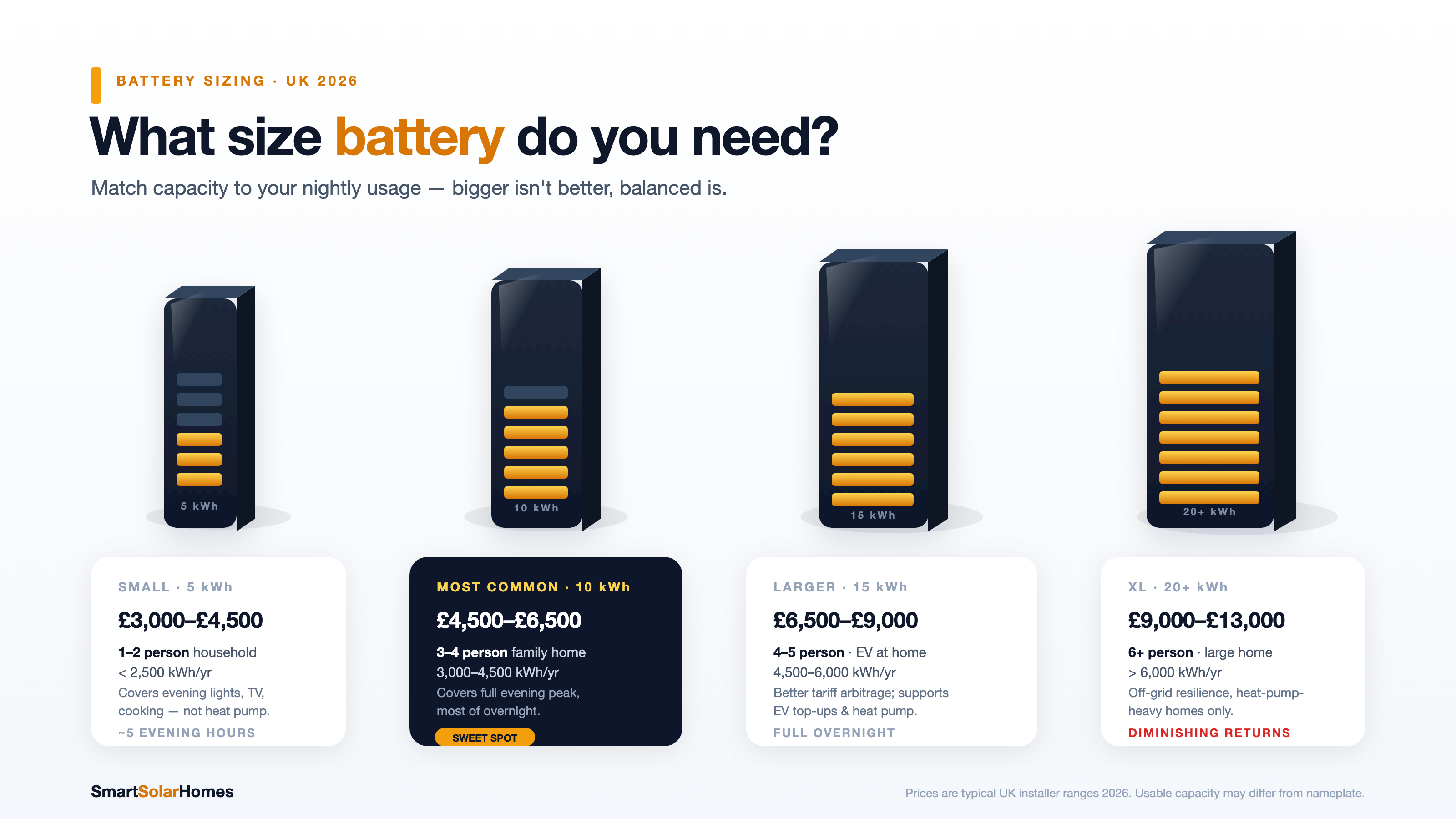
The rule of thumb is to match battery usable capacity to your typical evening electricity use — not your total daily usage. For a 3,500 kWh/year household, that is usually 4–6 kWh usable. Larger batteries improve resilience but extend payback proportionally. Our recommendation below is based on 60% of your daily usage stored at 90% depth of discharge.
DC coupling for DIY installs
If you are installing a string inverter (Step 3), you need an AC-coupled battery — one that has its own inverter built in and connects to the AC side of your system. DC-coupled batteries require a hybrid inverter. Make sure your chosen battery matches the coupling type of your inverter before ordering.
Skip this step?
If you want to add a battery later, or do not need one now, skip to Step 5 — you can always come back.
Enphase
IQ Battery 5P 5.0kWh
£2636.65 ex VAT
AC-coupled 5kWh module for Enphase microinverter systems. Plug-and-play, no separate hybrid inverter needed.
Sunsynk
L5.3 5.32kWh IP65
£1660.00 ex VAT
IP65 outdoor-rated LiFePO4 module designed to pair with Sunsynk hybrid inverters. 5.32kWh wall-mount.
Alpha ESS
Smile G3 10.1kWh All-in-One IP65
£2001.89 ex VAT
Korean-engineered AIO storage system. 10.1kWh + hybrid inverter, IP65-rated for outdoor install.
Fox ESS
EP5 Battery 5.18kWh
£1235.00 ex VAT
Stackable 5.18kWh LiFePO4 module for Fox ESS hybrid inverters. UK-popular mid-tier choice.
myenergi
Libbi Battery Pack 5kWh
£1524.28 ex VAT
Battery module for myenergi's Libbi ecosystem. 5kWh stackable LiFePO4, pairs with Libbi hybrid inverter.
SolarEdge
Home Battery 48V 4.6kWh
£2373.00 ex VAT
Low-voltage 4.6kWh battery designed to pair with SolarEdge Home Hub inverters.
Puredrive
PureStorage II 10kWh AC-Coupled
£2775.00 ex VAT
UK-designed AC-coupled 10kWh storage system. Retrofit-friendly, works with any existing solar PV.
Soluna
Battery Module 5kW Pack EOS
£1003.94 ex VAT
European-engineered 5kWh LiFePO4 module. Mid-price modular stackable for Soluna and third-party inverters.
Pylontech
US5000 5kWh
£787.58 ex VAT
UK's most-installed lithium battery module. 5kWh LiFePO4, 48V, stackable up to ~80kWh.
Solax
Triple Power 5.8kWh Master V3
£1286.48 ex VAT
High-voltage 5.8kWh master battery for Solax X3-Hybrid and X1-Hybrid inverters. Stackable up to 23kWh.
Pylontech
US3000C 3.5kWh
£815.00 ex VAT
Smaller Pylontech module for starter or capacity-constrained installs. 3.5kWh LiFePO4, 48V.
GivEnergy
All in One 13.5kWh + 5kW Inverter
£5700.09 ex VAT
UK-engineered all-in-one storage system from £5,700. 13.5kWh battery + 5kW hybrid inverter in a single weatherproof enclosure.
Sigenergy
SigenStor BAT 8.0 kWh with LED
£2300.12 ex VAT
New-generation modular battery from premium Chinese manufacturer. 8kWh stackable LiFePO4 with status LED.
Dyness
DL5.0C 5.12kWh
£650.00 ex VAT
Budget-tier 5.12kWh LiFePO4 module from Chinese tier-2 manufacturer. Wide inverter compatibility.
GivEnergy
9.5kWh LiFePO4 Battery
£3093.64 ex VAT
GivEnergy's standalone 9.5kWh LiFePO4 cell. Pair with any compatible GivEnergy hybrid inverter.
Compare batteries on Smart Solar Homes
Our battery storage comparison covers usable capacity, round-trip efficiency, LFP chemistry, and installed cost.
Read next
Background reading that adds depth to this step.